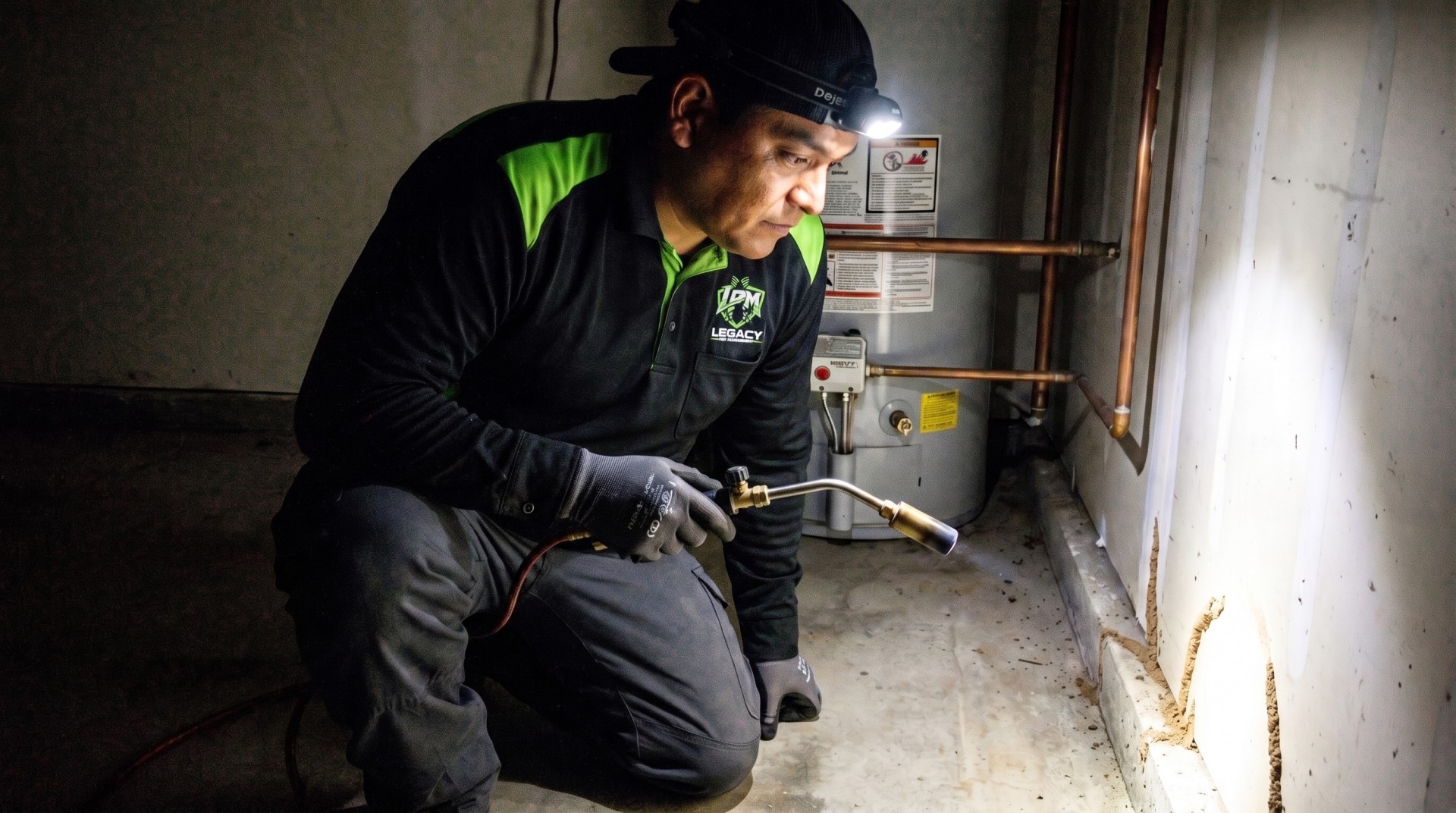
Termite treatment starts with identification, because the two species we deal with in San Diego County live in completely different places and the methods that work on one do not work on the other.
If you have not had an inspection yet, start with Termite Inspections. If you already know what you have, call 619-277-4796.
Because the colony lives entirely inside the timber and needs no ground connection, the treatment has to reach the wood rather than the soil.
Fumigation with sulfuryl fluoride treats the entire structure at once and reaches infestations nobody has found. That last point is the real argument for it: colonies are small, dispersed and hidden, and a structure can hold several at once.
Whole-structure heat works by raising all the wood to a minimum of 120°F and holding it there for at least 33 minutes. It is a chemical-free option with its own access and logistics requirements.
Individual boards can be treated directly with injected products, foams and dusts. It is less disruptive and appropriate for a limited, well-defined infestation.
The honest limitation is one UC states plainly: with localized treatment you can never be certain every infestation has been treated, because colonies hide behind finishes and inside voids. Its effectiveness depends almost entirely on how accurately the infestation was located.
Which of these fits depends on how extensive the activity is, how much of it we could actually find, the construction of the building and what you are willing to do. We will set out the options, explain the trade-offs, and tell you where the uncertainty sits rather than presenting one as the obvious answer.
Here the colony lives in the soil and comes up to feed, so the treatment addresses the ground and the connection.
Soil-applied termiticides are placed by trenching and injection around the structure, using non-repellent products the termites cannot detect and carry back through the colony.
Bait systems use stations containing slow-acting growth regulators that are shared through the colony over time.
All of the effective products are professional-use only in California. There is no consumer equivalent that does this job, which is worth knowing before spending money on something from a hardware shop.
Treatment alone is not the whole answer with subterranean termites, because the conditions that invited them are still there. Wood-to-soil contact, a damp crawl space, poor drainage and irrigation running against the foundation all need addressing or the pressure simply continues. Keeping structural wood twelve inches clear of soil is the usual benchmark.
A soil treatment does nothing for a drywood colony in a rafter. Fumigating a house whose problem is a mud tube from the garden is an expensive way to miss the point. The species decides the method, and the method decides the cost and the disruption.
That is why we will not quote a treatment for a house we have not looked at, and why an inspection that could not access the crawl space or the attic is worth saying so about.
Two things matter more than people expect.
Fix the conducive conditions. Drainage, ventilation, wood contact with soil, stored timber against the wall. Treatment resets the clock; conditions decide how fast it runs again.
Keep checking. Drywood colonies are slow and dispersed, so re-checking matters more here than speed does. Sweep up any pellets you find so you can tell fresh activity from old.
Parts of our service area, Mission Hills and Kensington in particular, hold a large number of individually designated historic homes. Designation can affect what you are permitted to do to the exterior of a structure, and that is worth confirming with the City's Historical Resources Board before committing to structural work.
We can inspect, tell you what we find, and set out the options. The permitting question is between you and the city, and we would rather flag it early than have it surface halfway through.
Not always. It depends on how widespread the activity is and how confident anyone can be that it has all been located. Whole-structure treatment buys certainty; localized treatment buys less disruption and carries more uncertainty. We will tell you which situation you are in.
The products that work on either species are professional-use only in California, and drywood colonies in particular are usually somewhere you cannot reach.
That depends on the method, the species and above all on whether the conducive conditions were fixed. A treated house with wood sitting on soil and a wet crawl space is a house on a shorter clock.
Possibly, and it does not automatically mean failure. Swarmers can come from a neighboring structure or a tree. Where they are appearing from matters more than that they appeared.
Termite Treatment is one half of our Termite Control service. The inspection settles which species and how far it has gone; the treatment follows from that.
Termite Treatment commonly overlaps with these:
We run termite treatment from both offices. See El Cajon or San Diego for the communities each one covers, or browse the full list of service areas. You can also send us a request, or read more about Legacy Pest Management.
Call 619-277-4796 or send a request and tell us what you are dealing with. We will recommend a plan that fits the property rather than a default package. We are open 24 hours a day, seven days a week.
Get Started
Tell us what you are seeing and where it is happening. You will get an honest assessment of the problem, what it takes to solve it, and whether your property needs ongoing service or a single visit. Pest, wildlife and termite work across San Diego County.