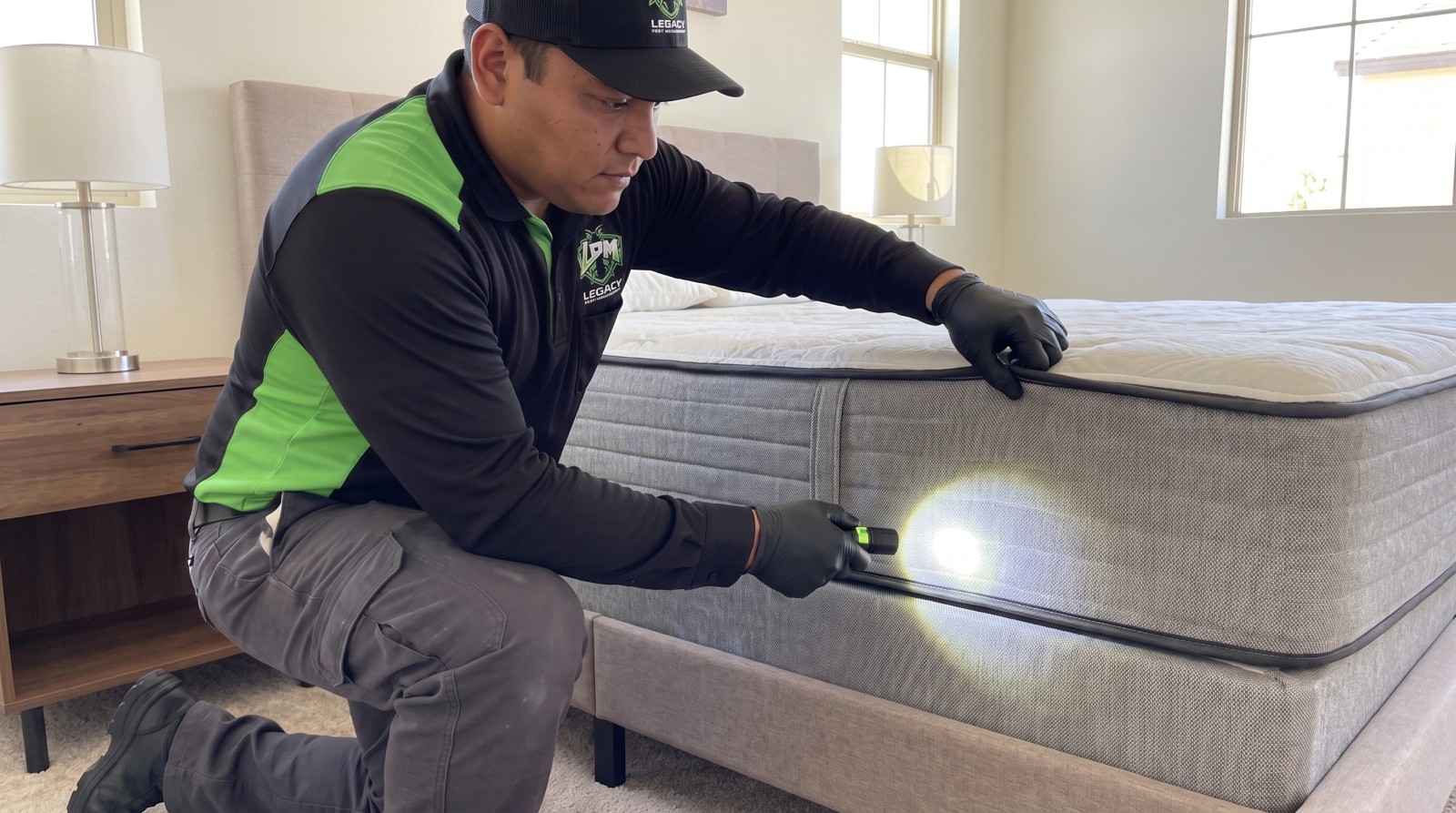
Bed bugs are the pest people most often get wrong in both directions. They cause real distress and considerable expense, and they also carry a set of assumptions that are simply not true. It is worth being straight about both.
Call 619-277-4796 and describe what you have found.
Bed bugs have never been shown to transmit human disease. That is UC's position and it is worth stating plainly, because a great deal of marketing implies otherwise. The genuine problems are the bites, the loss of sleep, the anxiety, secondary infection from scratching, and the cost of dealing with an established infestation. Those are enough. Nobody needs the disease angle added on top.
The second correction: an infestation is not a verdict on cleanliness. Bed bugs travel with people and belongings, and they turn up in the best accommodation as readily as anywhere else.
About 85 percent of bed bugs are found in or immediately around the bed. The remainder are in upholstered furniture, cabinets, baseboards, wallpaper, carpets and wall hangings.
That is useful, because it makes inspection focused rather than open-ended. It also means that if someone proposes treating an entire property uniformly, they are not working from where the insects are.
Bed bugs feed at night on sleeping hosts. A single feed takes three to ten minutes and the insect can take up to six times its own weight in blood. They inject a natural anesthetic, which is why the bite itself is not what wakes anyone.
Heat is effective, and the numbers matter because underdone heat treatment is worse than none. The minimum lethal temperature is 113°F, and the recommended protocols are 140°F held for two hours, or 130°F held for three. Below that, insects survive in cooler pockets.
For anything launderable there is a version you can do yourself: a household dryer on high for ten to fifteen minutes is effective. Bedding, clothing, curtains, soft toys.
Worth knowing as a consumer: in California, companies providing heat treatment must be licensed and bonded through the Structural Pest Control Board. That is a fair question to ask any provider before booking.
Pyrethroid resistance has been documented in bed bug populations, which is part of why treatments that worked a decade ago sometimes do not now. Alternatives include chlorfenapyr, insect growth regulators, botanical oils and product mixtures, and rotating chemistry matters.
This is also why a single application rarely finishes the job, and why anyone promising one visit and done is describing a best case rather than a plan.
Turnover is the driver. Short-term rentals, apartments, hotels and student housing carry more exposure than an owner-occupied street, because bed bugs move with people rather than through the building.
That is an important distinction from cockroaches: the shared-plumbing mechanism that carries roaches between units does not apply here. Bed bugs travel in luggage, bedding, clothing and second-hand furniture. Adjacent rooms are still worth inspecting when something is found, because people and their belongings move between them.
For owners and managers we can provide written documentation of what was found and treated, which is generally what is needed for records, a lease conversation or a platform dispute.
Rarely enough on its own, and a discarded mattress carried through the property can spread them. Encasements are often more useful than replacement.
Bites alone are not diagnostic. People react very differently and several insects produce similar marks. Physical evidence, fecal spotting, shed skins, live insects, is what confirms it.
Usually not. Most items can be treated or heat-treated. We would rather save the furniture than add cost.
Rarely. Eggs and documented insecticide resistance both argue for follow-up, and anyone promising a single visit is describing the best case.
Possibly, and it does not much matter for the treatment. What matters is the scope now, and what has been moved around since.
Bed Bug Treatment commonly overlaps with these:
We run bed bug treatment from both offices. See El Cajon or San Diego for the communities each one covers, or browse the full list of service areas. You can also send us a request, or read more about Legacy Pest Management.
Call 619-277-4796 or send a request and tell us what you are dealing with. We will recommend a plan that fits the property rather than a default package. We are open 24 hours a day, seven days a week.
Get Started
Tell us what you are seeing and where it is happening. You will get an honest assessment of the problem, what it takes to solve it, and whether your property needs ongoing service or a single visit. Pest, wildlife and termite work across San Diego County.