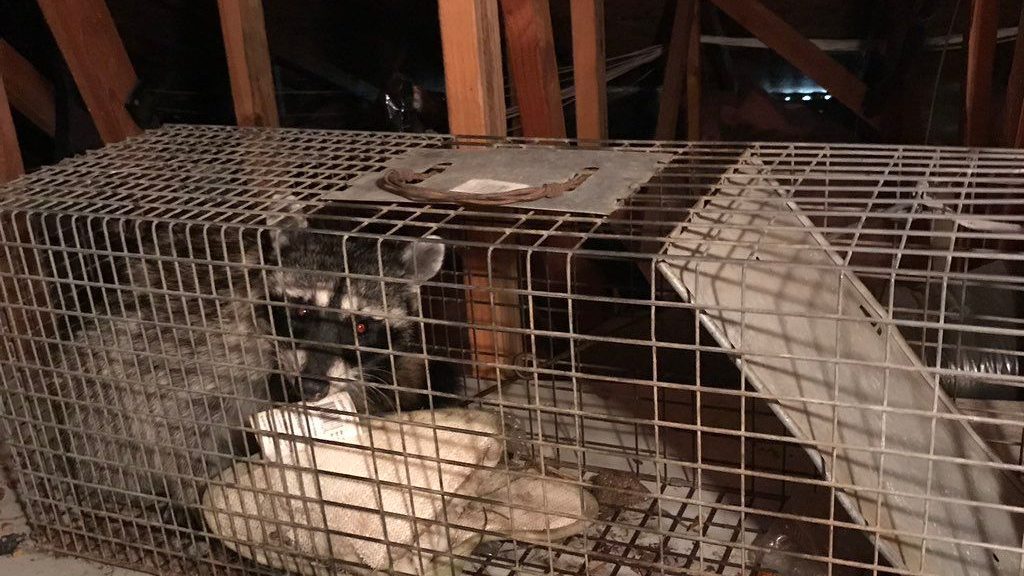
A raccoon in an attic is not a pest problem in the usual sense. It is a large, strong, intelligent animal that has decided your roof space is a better den than a hollow tree, and it is right. Attics are dry, warm, undisturbed and safe from coyotes. Once one has moved in, spraying nothing and trapping alone solves nothing. The job is to get the animal out and close the way it came in.
Wildlife Removal at Legacy is exclusion led for exactly this reason, and raccoons are the clearest case for it.
Raccoons do not usually find a hole. They make one. UC's guidance is blunt about it: they will rip off shingles, fascia boards and rooftop ventilators to get into an attic. On San Diego County houses the usual routes are the roof-to-fascia gap where a lower roof meets a wall, a dislodged turbine or box vent, a soffit return, and the space behind a fascia board that has softened with age.
Under the house it is simpler. A foundation vent with a rusted or missing screen, a crawl space access door that no longer sits flush, or a gap where a utility line passes through the stem wall.
The tell is almost always sound before sight. Heavy movement overhead, not the scurrying of rats. Thumps rather than scratching. Vocalisation at dusk and again before dawn.
Raccoon young are typically born in April or May, though earlier and later litters are common enough to matter, and a litter averages about four.
This is the single most important thing to establish before anyone seals anything. A female raccoon denning in an attic in spring is almost certainly not alone, and the kits are immobile for weeks. Sealing the entry at that point does not remove the problem. It leaves dependent animals in your ceiling, and the outcome is exactly what you would expect: odour, flies, and a repair bill that dwarfs the original job.
So the inspection establishes whether young are present before any decision is made. Where they are, the work is staged around them rather than forced through.
Raccoons defecate in a consistent spot. In an attic that means a latrine, usually near the entry or on a horizontal run of framing, and it is the part of the job with an actual health consequence attached.
Raccoon roundworm eggs are shed in the faeces and become infective after a period in the environment. Infection in people comes from accidental ingestion or inhalation of those eggs, and young children are the most susceptible group because of how they behave around contaminated material. This is the reason prompt cleanup matters and the reason a latrine is handled with proper respiratory protection rather than a shop vac and a mask from the garage.
It is also why "we got the raccoon out" is an incomplete job. The contamination stays until it is removed.
The sequence does not vary much.
First, a full inspection of the roofline, attic and any crawl space to find every opening, not the obvious one. Raccoons commonly maintain more than one way in.
Second, establishing whether young are present, and where.
Third, getting the animals out. Where one-way doors are appropriate, they let the animal leave under its own power and prevent it returning. Where they are not, other methods apply.
Fourth, sealing. Raccoons are strong enough that light mesh is decorative. Foundation and crawl space work uses quarter-inch hardware cloth, buried where digging is a risk, and roof repairs are made in materials that hold.
Fifth, the latrine and any contaminated insulation. See Wildlife Removal for the general approach and how attic work is scoped.
Raccoons are classified as furbearers in California, and state regulations prohibit relocating them without written permission from the California Department of Fish and Wildlife.
That rules out what a great many pest control websites promise: catching your raccoon and releasing it somewhere leafy. A healthy adult is released on site, and no company can lawfully offer you the other version as a matter of routine.
What the law does allow is different, and it is the part most companies never mention. An animal that is injured, sick or orphaned can be taken to a permitted wildlife rehabilitation facility, whose defined purpose in the regulation is to restore it to health for release back into the wild. In this work the animals that matters most for are the kits, because a spring attic job routinely turns up young that cannot leave on their own. Where the mother is still present the first move is always to reunite them so she carries them out herself. Where she is not, they go to a rehabilitator.
Euthanasia is what the rules permit for an animal too sick or injured to treat. It is not our default and it is not how we like to finish a job.
None of that weakens the exclusion argument, it sharpens it. If a healthy adult can only be released where it was caught, the only thing that actually ends the problem is closing the building.
Which is, once you sit with it, the strongest argument for doing the work the way we do. If an animal that is removed can only be released where it was caught, the only thing that actually ends the problem is closing the building. Exclusion is not the premium option. It is the part that works.
Weight is the giveaway. Raccoons produce heavy, deliberate movement and you can often hear direction. Rats sound like fast scratching and running, usually along a wall line. If it is rats, that is Rodent Control, which is a different job.
Not without knowing whether young are inside, and not in spring. It is also common to seal one entry while a second stays open, which achieves nothing.
Not through a properly closed entry. Raccoons do test the building, so the quality of the seal is the whole game. That is where the money should go.
Sometimes. Contaminated or compressed insulation loses its function and holds odour that attracts the next animal. It is assessed on what is actually there rather than sold by default.
Raccoon work is part of Wildlife Removal, alongside Opossum Control, Skunk Control and Bird Control. Where the noise turns out to be rodents rather than wildlife, see Rodent Control.
We handle raccoon work from both offices. See El Cajon or San Diego for the communities each covers, or browse the full list of service areas. You can also send us a request, or read more about Legacy Pest Management.
Tell us what you are hearing and where, and roughly how long it has been going on. If it is spring, say so, because that changes what we check first.
Get Started
Tell us what you are seeing and where it is happening. You will get an honest assessment of the problem, what it takes to solve it, and whether your property needs ongoing service or a single visit. Pest, wildlife and termite work across San Diego County.