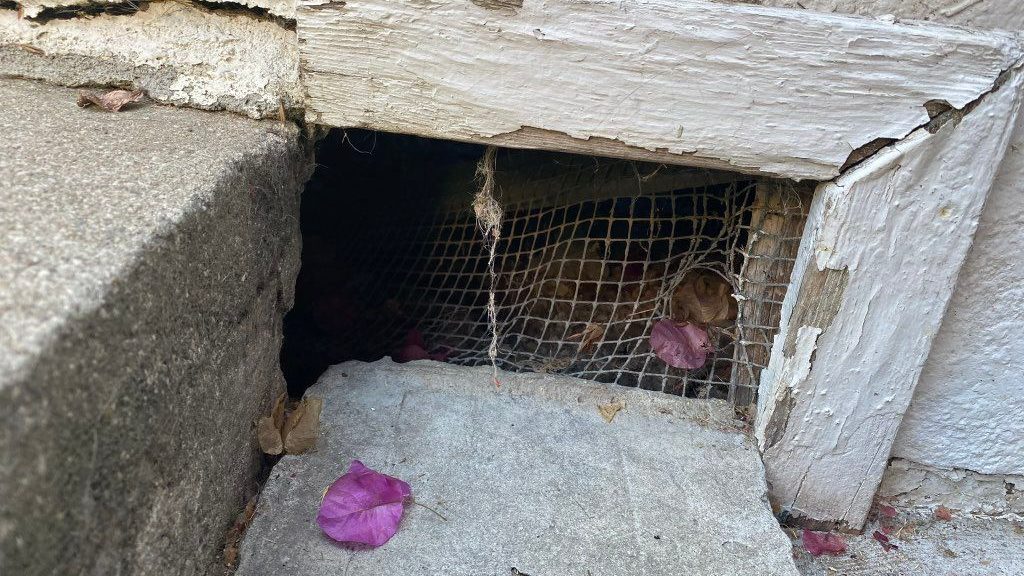
Most people call about a skunk after they smell one, and by then the animal has usually been living under the deck for a while. Skunks are quiet tenants. They dig little, damage less than a raccoon, and give almost no warning until something startles one.
The job has two halves and both matter: getting the animal out without triggering a discharge under your house, and closing the space so the next one does not move in. That is Wildlife Removal as we run it.
Skunks prefer a burrow somebody else dug. In an urban setting that means the void under a porch, a deck, a shed or a foundation, and if nothing suitable exists they will dig their own.
What makes a property attractive is boring and fixable: an unsealed skirt around a raised deck, a foundation vent with a failed screen, a gap under a shed that has settled on soft ground, and a reliable food source. Pet food left out overnight and fallen fruit do more to keep skunks on a property than anything else.
The early signs are shallow cone-shaped diggings in the lawn, where a skunk has been working for grubs, and a faint musk near an opening long before any real spray event.
Striped skunks breed in February and March. Gestation runs about nine weeks, so kits arrive in spring, four to six of them, and they are not out following their mother until they are two or three months old.
That gives a long stretch each year when sealing a den means sealing in animals that cannot leave. It is the same failure as with raccoons and it produces the same result, with the added feature that a skunk dying under a deck announces itself for a considerable time.
So the first question is always whether kits are present, and in spring the answer is often yes. Where they are, the work waits or is staged rather than forced.
A skunk can spray accurately at six to ten feet. It is a defensive act, not an aggressive one, and it is preceded by warning: stamping, a raised tail, a turn to face away. Give a skunk room and it will almost always choose not to.
What matters practically is that a discharge under a house pushes odour into the structure through the same gaps that let the animal in, and it can persist for weeks. This is the main reason skunk work is not a matter of poking around under a deck with a flashlight.
On the cleanup, the tomato juice remedy does nothing. The mixture that actually works is hydrogen peroxide, baking soda and a little dish soap, mixed fresh and used immediately, because it is the oxidation that neutralises the thiols rather than the masking. It cannot be bottled and stored. For a pet, keep it well away from the eyes.
Skunks are one of the two main rabies reservoirs in California, along with bats. UC describes them as one of the most common carriers in the state, and the Department of Fish and Wildlife cites rabies prevalence as a reason relocation permits are denied.
That is a real consideration and it is why a skunk behaving oddly, out in daylight, disoriented or unusually bold, is a call to animal control rather than a job to handle yourself. It is also not a reason to panic about a skunk quietly using a burrow at night, which is normal behaviour.
We will tell you which of those two you are looking at.
Inspection first, to find every opening rather than the one you noticed, and to establish whether kits are present.
Then getting the animals out, using one-way doors where they suit the situation so the skunk leaves under its own power and cannot get back. This avoids handling, which avoids the discharge.
Then sealing, in quarter-inch hardware cloth, buried to about six inches where the ground allows, because a skunk that wants back in will dig at the edge of anything that is merely laid against the gap.
Then the property itself. Securing pet food, dealing with fallen fruit, and closing the other three voids on the property that were going to be next.
Skunks are nongame mammals in California and relocating them without written permission from the Department of Fish and Wildlife is prohibited.
So a healthy adult skunk is released on site rather than driven somewhere else and let go, whatever a website says.
An injured, sick or orphaned animal is a different case. Those can be taken to a permitted wildlife rehabilitation facility, whose purpose under the regulation is to restore an animal to health for release back into the wild, and kits found under a deck in spring are exactly that case. Euthanasia is what the rules permit for an animal too sick or injured to treat. It is a last resort here, not a default.
Once that is clear, exclusion stops looking like the expensive option and starts looking like the only one that ends the problem.
Often, yes. A faint persistent musk near a vent or deck skirt usually means a den rather than a passing animal, which leaves a stronger and shorter-lived smell.
The source has to go first, and then odour treatment is worth doing. Treating the smell while the animal is still resident is money spent twice.
Fresh hydrogen peroxide, baking soda and dish soap, mixed and used straight away, kept away from the eyes. Do not bottle it and do not use tomato juice.
Not through a properly sealed and buried barrier. They will absolutely come back through a screen that was stapled over a vent.
Skunk work sits under Wildlife Removal, with Raccoon Control, Opossum Control and Bird Control. Lawn diggings that turn out to be something else are covered by General Pest Control.
We handle skunk work from both offices. See El Cajon or San Diego for the communities each covers, or browse the full list of service areas. You can also send us a request, or read more about Legacy Pest Management.
Tell us where the smell is strongest and whether you have seen diggings in the lawn. If it is spring, mention it, because kits change the sequence.

Get Started
Tell us what you are seeing and where it is happening. You will get an honest assessment of the problem, what it takes to solve it, and whether your property needs ongoing service or a single visit. Pest, wildlife and termite work across San Diego County.