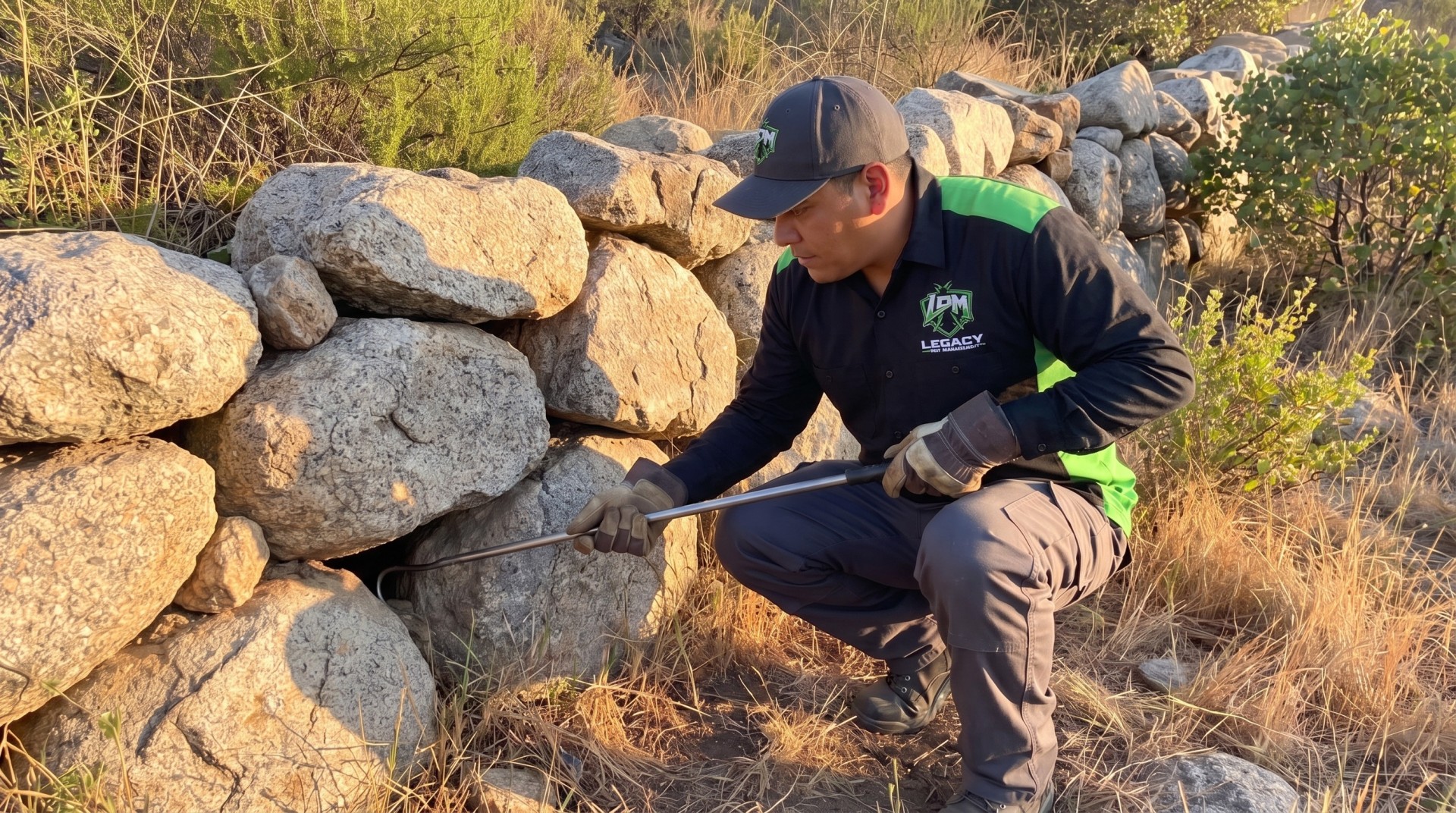
Most snake calls end with us telling the homeowner the snake is harmless and explaining what to do differently around the yard. That is a real outcome, not a wasted visit, and it is the one we get to most often.
Call 619-277-4796. If it is safe to do so from a distance, a photograph settles almost everything. We are open 24 hours a day, seven days a week.
Four rattlesnake species are documented in San Diego County.
One species you will see on other San Diego pest control websites that we are not going to list: the Mojave rattlesnake. Its California range is the Mojave and the southeast — San Bernardino, Kern, Inyo, Los Angeles. Even the City of San Diego, which mentions the name, concedes there are no documented county cases. It is a piece of local folklore that keeps getting repeated by people selling snake control.
Under California regulations the red diamond rattlesnake has a bag limit of zero. It cannot lawfully be taken or killed anywhere in the state, and it is also a Department of Fish and Wildlife Species of Special Concern.
It also lives in exactly the rocky coastal-foothill chaparral where a great many San Diego County homes sit.
So identifying the species is not an academic nicety. Killing the wrong rattlesnake in this county is illegal. Most rattlesnakes in California can be taken on private land without a licence, with a limit of two a day — but not that one.
Several harmless local species are also closed to take in San Diego County specifically, including the glossy snake, the common gartersnake, the coast patch-nosed snake and the San Diego mountain kingsnake.
The San Diego gophersnake is the animal most often killed by mistake, and the reason is that the usual advice is wrong.
Head shape does not work. A threatened gopher snake flattens its head deliberately, which is precisely when a homeowner is looking at it. It also coils, hisses loudly, and vibrates its tail — which in dry leaf litter sounds a great deal like a rattle.
Pupil shape does not work either. Rattlesnakes do have vertical pupils and heat-sensing pits, but reading them means being inside strike range. That is not advice, it is a hazard.
What is actually reliable, from a safe distance:
Two cautions. A rattle can break off, and a newborn rattlesnake has only a button that makes no sound at all. Silence proves nothing.
The San Diego Natural History Museum gives the same advice we do: if you do not know, leave it alone.
This one deserves a straight answer, because the industry is vague about it.
Reptiles in California are governed by their own regulations, separate from the mammal rules. The baseline is that native reptiles may not be captured, possessed, transported or released except as the regulations allow, and a reptile that has been in captivity may not be released back into the wild without written departmental approval. Fish and Wildlife's own position, stated publicly, is that relocating a captured rattlesnake requires that written approval.
So a company advertising that it will catch your rattlesnake and release it somewhere leafy and far away is describing something that needs a permit most companies do not hold. We would rather tell you that than imply otherwise.
What we do instead is deal with the property. Removal of the immediate animal from where it is a danger, and then the work that actually changes the odds.
Rodents. That is not a deflection, it is the mechanism.
Adult rattlesnakes hunt rodents, and they shelter in rodent burrows. The County's own guidance to homeowners is to remove the food source. So a snake problem on a San Diego County property is very often a ground squirrel problem or a rat problem wearing a different hat, and treating it as a snake problem alone gets you a repeat visit.
The full picture:
Where there is a pool yard, a play area or a kennel worth protecting, fencing is a real option. The specification the wildlife-damage literature supports is quarter-inch galvanised hardware cloth, 36 inches high, buried four to six inches, slanted outward at about 30 degrees, with support stakes on the inside and gates that swing inward. Vegetation just outside has to be kept mown, or a snake climbs the plant rather than the fence.
Honest caveat: this is the standard specification in the extension literature, not something with a published exclusion percentage behind it. And it is only practical on small areas — a perimeter, not a parcel.
Flatly. University of California states that none of the commercially available snake repellents have been proven to work well enough to warrant recommendation, and that the folk remedies — horsehair ropes, sulfur dust, mothballs — do not work. When the sulfur-and-naphthalene formulation was actually tested, around 78 percent of snakes crossed the treated barrier, no different from controls.
Mothballs deserve their own sentence, because it is not only a question of efficacy. Mothballs are labelled for killing clothes moths inside a closed container. Using them outdoors against snakes or other wildlife is an illegal off-label pesticide use. Any licensed operator recommending it to you is recommending you break the law, and any company selling it as a service should worry you.
Follow California Poison Control.
Do: stay calm, call 911, call the poison hotline on 1-800-222-1222, get to a hospital — antivenom is the treatment. Move beyond striking distance, avoid exertion, remove rings and watches before swelling starts.
Do not: apply a tourniquet or constricting band, cut the wound, attempt suction or use an extractor device, apply ice or heat, use electroshock, or drink alcohol.
There is no safe field treatment for envenomation. The treatment is at the hospital.
Do not touch the snake even if it appears dead. A dead rattlesnake can still inject venom shortly after death.
They are not, and this was settled by research published in 2026. Juvenile venom can be more toxic drop for drop, but that does not overcome how much less of it there is, and juveniles do control venom release — the old idea that they cannot is wrong. Adults deliver substantially more venom and cause substantially more severe envenomations.
The study also found 73 percent of surveyed emergency responders and health professionals believed the myth, which is a problem in its own right. A baby rattlesnake bite is still a medical emergency and still needs antivenom. It is just not worse than an adult one.
Fish and Wildlife describes them as generally defensive rather than aggressive. The sequence is: stay still, rattle, leave. Given space and time they crawl away.
Most bites happen when somebody tries to pick up, move or kill the snake. More than half of venomous snakebites in the United States are classified as illegitimate — the person saw the snake and chose not to walk away.
Activity picks up in late winter and early spring, usually around March and April in this county, but rattlesnakes can appear year-round here — they brumate rather than truly hibernate, and a warm winter day brings them out.
In hot months they are most active at dawn, dusk and after dark, avoiding midday heat. That is the reverse of what most people assume, and it is the single most useful thing to know if you walk a dog or garden in summer.
It means one was there. Bring us the skin or a photograph of it — it often identifies the species and tells you whether it matters.
No, and nobody can. What can be changed is whether your property offers food and shelter, and that changes the odds substantially.
Veterinarian immediately. Many now carry antivenom, and there is a vaccine. Ask your vet whether it makes sense for where you live and how your dog is exercised.
Aside from the red diamond, where it is illegal — most bites happen during exactly that attempt. Leave it alone and call.
Snake work is part of Wildlife Removal and almost always runs with Rodent Control and Exclusion & Sealing. Where the concern is what else is under the house, see Crawl Space Treatment.
We take snake calls across the county from both offices. See El Cajon or San Diego for the communities each covers, or browse the full list of service areas. You can also send us a request, or read more about Legacy Pest Management.
Send a photograph from a safe distance if you can, and tell us where on the property it is and whether there are children or pets with access. Do not approach it to get a better picture.
Get Started
Tell us what you are seeing and where it is happening. You will get an honest assessment of the problem, what it takes to solve it, and whether your property needs ongoing service or a single visit. Pest, wildlife and termite work across San Diego County.