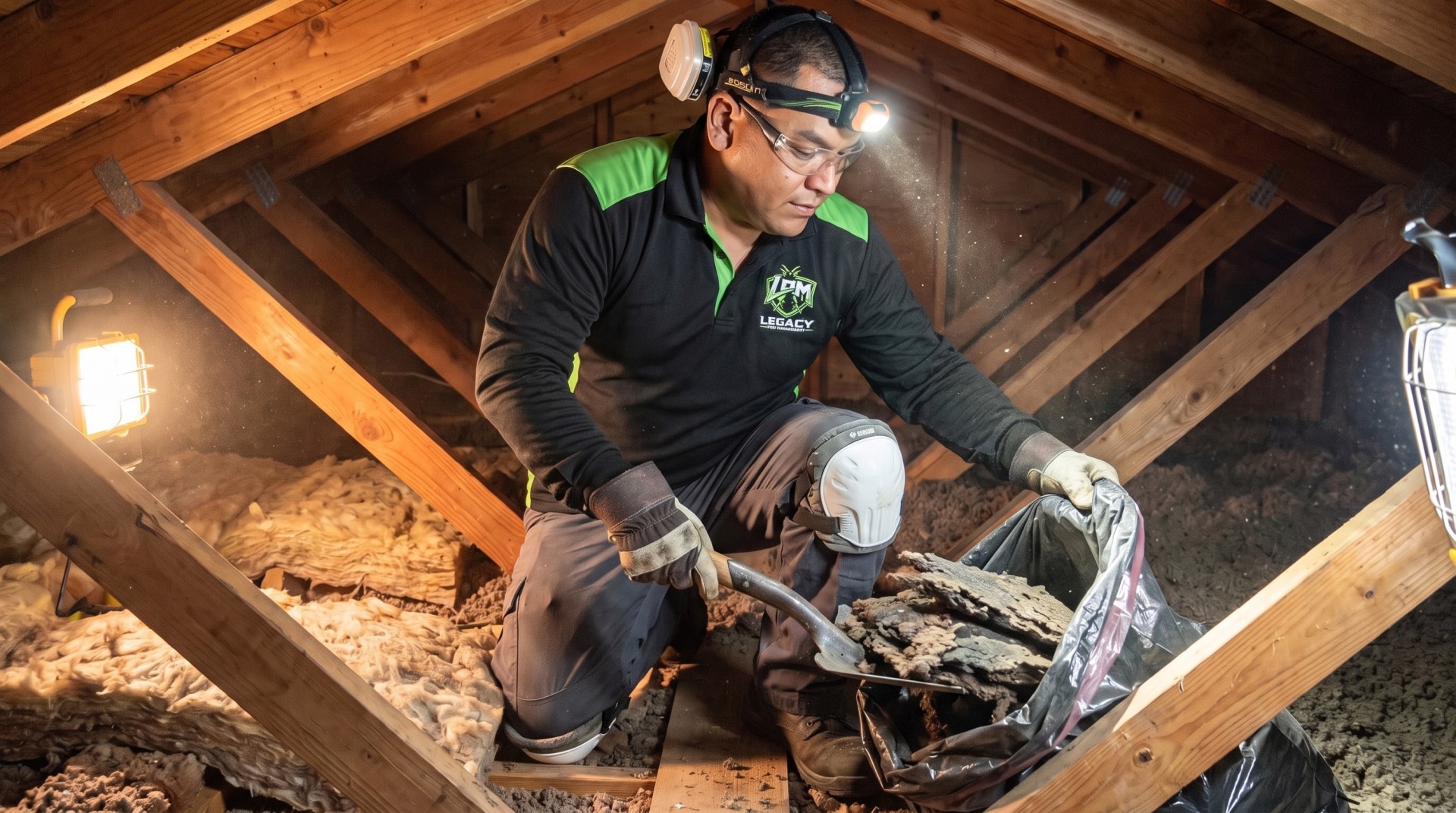
When an animal has been living in an attic, getting it out and sealing the way in deals with the animal. It does not deal with what it left behind.
Call 619-277-4796 and tell us what was up there and roughly how long. We are open 24 hours a day, seven days a week.
Attic sanitation is one of the most over-sold services in this industry, so it is worth being straight about it before anything else.
Not every rodent job needs the insulation replaced. There is no CDC, state or University of California guidance saying that any sign of a rodent means the attic has to be stripped. Light, localised droppings on insulation that is otherwise intact, with the entry properly sealed, is a spot-clean. We will tell you that, and we would rather lose the add-on than sell it to you.
Full removal and replacement genuinely earns its cost when one of these is true:
Raccoons defecate in a consistent spot. In an attic that becomes a latrine, usually near the entry or along a run of framing, and it is the part of this work with a real consequence attached.
Raccoon roundworm eggs are shed in the faeces. They are not infective when passed — they need two to four weeks in the environment to develop. That window is the whole reason prompt removal matters. Once they are infective they stay viable for years, and infection in people happens by accidentally swallowing them, which is why young children are the group at risk.
Here is the part almost nobody tells homeowners: disinfectant does not kill them. In testing, undiluted household bleach for ninety minutes did not affect egg viability. Bleach strips the sticky coat off the egg; it does not destroy it. What destroys them is heat, or physically removing the contaminated material.
So if a company tells you they will fog or spray your attic and that will handle raccoon roundworm, they are describing something that does not work.
This is not theoretical in Southern California. Studies here have found roundworm eggs in roughly half of surveyed raccoon latrines, with a large share of latrines found on roofs. Two Los Angeles County children were diagnosed in 2024; one of them was traced to a latrine on the roof of his own home.
Both of these are standard in pest control advertising and both are wrong often enough to matter.
The California reservoir for hantavirus is the deer mouse. A statewide survey of more than 1,600 house mice and rats found infection rates too low to be epidemiologically important. If what was in your coastal San Diego attic was a roof rat, hantavirus is not the reason to do this work.
Deer mice are a genuine consideration on rural, foothill and backcountry properties, and where they are involved we take the aerosol route seriously, because the disease is rare but severe.
Histoplasmosis is a real hazard of large dropping accumulations — in the Ohio and Mississippi valleys. University of California states plainly that the fungus rarely occurs in California. We still use the dust control and respiratory protection the guidance specifies for large guano accumulations, because that is correct practice regardless. We are not going to tell you it is why you need the job.
The strongest argument for physically removing nesting material is not a headline disease. It is parasites.
Tropical rat mites live in roof rat nests and runways. Bird and chicken mites live with pigeons, starlings, sparrows and swallows. All of them will bite people. University of California ANR puts it directly: a successful rat control programme can leave hundreds of starving mites wandering in search of a blood meal, and tropical rat mites survive six weeks or more without their host. When a bird nest is vacated, the mites move into the living space below.
People describe biting and irritation with nothing visible, because the mites are very small, and the treatment fails until the nest itself is gone. Removing the host and the nesting material is the control.
Compression, yes, measurably. Fibreglass batt data shows an R-30 batt compressed to seven and a quarter inches performs at about R-24, and at three and a half inches at about R-13. Rodent tunnelling, matting and trampling do exactly that — they take away thickness and open bypasses.
The honest framing: it is a thickness and coverage problem, not chemical degradation of the fibre. Wet insulation also performs badly, which is well established. We are not going to quote you a precise percentage loss from urine contamination, because no study establishes one and the numbers that circulate are invented.
Odour comes from urine, droppings and nesting material, so removing them is most of the answer. Anything applied afterwards is a finishing step.
We are careful about how this is described, and there is a reason. Under federal pesticide law, the moment a product is advertised as controlling the bacteria or pests that cause odours, it becomes a pesticide requiring registration. Plain deodorising claims do not. We will tell you what a product does and does not do rather than implying it sterilises your attic.
If what you have is bats, none of the above starts yet.
Exclusion cannot be done while flightless pups are present. In California that window is roughly May through September, and sealing during it traps young inside to die. The work is done with one-way devices left in place for a week or more, never by sealing first, and then every opening a thumb fits into is closed.
Do not handle bats, live or dead. Guano cleanup follows the same wet-and-remove discipline with a powered respirator.
Sometimes, and if that is the honest answer you will get it. Where nesting material is embedded, treating around it does not resolve the mite problem.
Sometimes, particularly where there is structural damage. It varies enormously by policy and we are not going to guess at yours. Document everything and ask your carrier.
A straightforward attic is usually a day. A large latrine cleanup with full removal and re-insulation can be longer.
No, and be wary of anyone selling it. There are no established indoor limits to test against.
This work follows Exclusion & Sealing and Wildlife Removal, particularly Raccoon Control and Bird Control. Where the animal was a rodent, see Rodent Control; where mites or fleas have come indoors, see Flea & Tick Treatment. Below the floor rather than above the ceiling is Crawl Space Treatment.
We handle attic work from both offices. See El Cajon or San Diego for the communities each covers, or browse the full list of service areas. You can also send us a request, or read more about Legacy Pest Management.
Tell us what was in the attic, how long it was there, and whether the entry has already been sealed. A photograph from the hatch is usually enough for us to tell you whether this is a spot-clean or a full removal.

Get Started
Tell us what you are seeing and where it is happening. You will get an honest assessment of the problem, what it takes to solve it, and whether your property needs ongoing service or a single visit. Pest, wildlife and termite work across San Diego County.