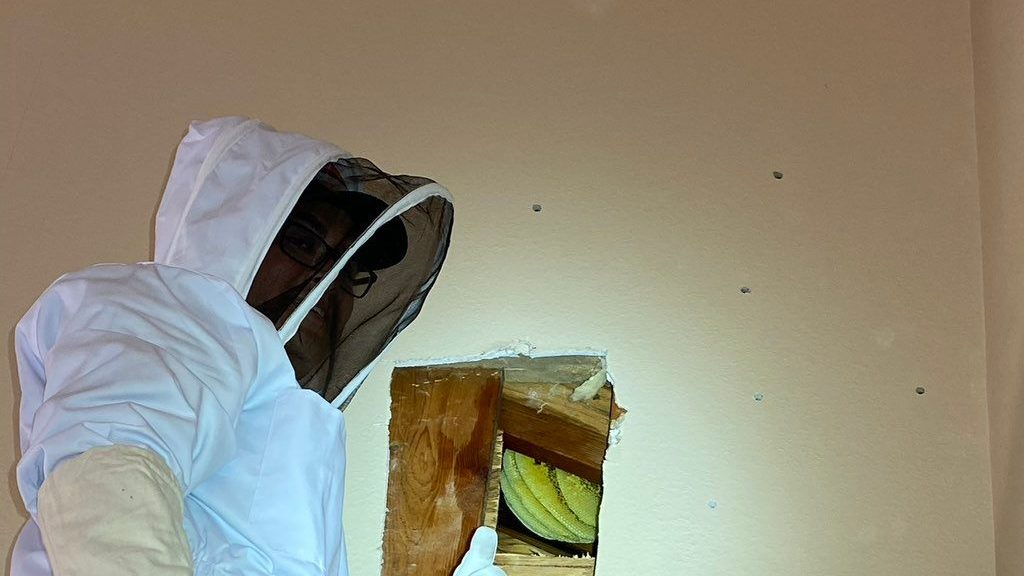
Bees, wasps and hornets get grouped together because they sting. For the work itself they have almost nothing in common, and the first useful thing we do on any of these calls is establish which one you actually have.
Call 619-277-4796. Tell us where the activity is, whether you can see a nest, and whether anyone in the household reacts badly to stings.
Honey bees are fuzzy, amber and brown, and a colony builds wax comb. That comb is the reason honey bee work is different from everything else on this page.
Paper wasps build the open, umbrella-shaped gray nest you see hanging under eaves and in patio covers, with the cells visible from below.
Yellowjackets are smooth and brightly banded yellow and black. They nest in the ground, in wall voids and in other cavities, and they are the ones most often encountered around a bin or a picnic table. They are behind most late-summer stinging complaints here, and they are the most likely to be inside a wall rather than on it.
Mud daubers build small mud tubes and are not aggressive. Often the right answer with these is to leave them alone.
Worth knowing about, and worth keeping in proportion. Africanized honey bees were first detected in California in 1994 and have since become the predominant feral bee population in the region. That means a wild colony in a wall or a tree in San Diego County is reasonably likely to have Africanized genetics.
The practical difference is not that individual stings are worse. It is that they defend the colony in much greater numbers and will pursue an intruder further. A colony that would produce a few defensive bees elsewhere can produce a great many here. That is why we do not recommend anyone approach an established colony to have a look, and why disturbing one with a hose or a ladder is a genuinely bad idea.
There is a related point worth being honest about. UC guidance notes that in Africanized bee regions, which includes all of Southern California, pest control companies are often the only viable option, because many beekeepers will not collect feral colonies. We would rather a colony be relocated by a beekeeper where that is possible, and will say so when it is.
This distinction saves people money regularly.
A swarm is a temporary cluster, usually hanging on a branch, a fence or a wall while scouts look for a permanent home. It has no comb and no stores. It is generally not aggressive, and it will very often move on by itself within a day or two. A beekeeper can frequently collect one intact.
An established colony inside a wall, a soffit, a chimney or an outbuilding is a different situation. There is comb, there are stores, and there is a structure to defend.
If you can see a cluster of bees hanging in the open, tell us that on the phone. It may not need paid work at all.
This is the part most people are not told, and it is the difference between a job that is finished and a job that comes back worse.
If the bees are killed and the comb is left inside the wall, the colony is no longer maintaining it. The honey ferments and leaks, staining and coming through drywall and ceilings, sometimes weeks later. It then draws ants, cockroaches and other bees. Bees may also chew through drywall to expand a nest, creating damp spots and structural problems.
So honey bee removal from a structure means opening the void, removing comb and stores, cleaning, and sealing the cavity so it is not simply reoccupied by the next swarm that finds it. It is closer to a small construction job than to a spray.
Do not seal the entrance. It is the most common instinct and it makes everything worse: the bees are trapped inside with the comb, they look for another way out, and that way is often into the room.
No comb to remove, so the work is different. It is about locating the nest, which is frequently not where the activity is visible, treating it safely, and then closing the void so it is not reused.
Season matters more than people expect. A wasp or yellowjacket colony starts small in spring with a single overwintered queen and builds through the summer. A nest nobody noticed in May can be very large and very defensive by August or September. That is when most calls come in and also when the colony is least tolerant of disturbance.
Ground nests in a lawn, a slope or a retaining wall are a different access problem from a nest in a soffit, and both are worth leaving alone until they can be handled properly. A partially treated nest, or one disturbed without protective equipment, is how people get stung repeatedly rather than once.
Tell us when you call. It changes how we schedule and how we advise you to use the area in the meantime.
If anyone in the household has a known severe allergy, stay away from the nest entirely and do not attempt any DIY treatment. That is the situation where the risk is immediate and real, and it is not worth the ladder.
That sounds like a swarm rather than a colony. They often move on within a day or two by themselves, and a beekeeper can frequently collect one. Call and describe it before assuming it needs treatment.
No. It traps the colony inside with the comb, and they will look for another way out, which is often into the living space. It also leaves the comb to ferment.
A swarm often can be, and a beekeeper is the right call for that. An established colony inside a wall is harder, and in Africanized bee regions many beekeepers will not take feral colonies. We will tell you honestly which situation you have.
Usually a void that is attractive rather than a colony that survived. Closing the cavity after treatment is what stops the pattern.
We would rather you did not, particularly from August onwards when colonies are large, and particularly with yellowjackets or anything you cannot fully see. A partial treatment leaves a defensive colony and an aggravated one.
Bee, Wasp & Hornet Control commonly overlaps with these:
We run bee, wasp & hornet control from both offices. See El Cajon or San Diego for the communities each one covers, or browse the full list of service areas. You can also send us a request, or read more about Legacy Pest Management.
Call 619-277-4796 or send a request and tell us what you are dealing with. We will recommend a plan that fits the property rather than a default package. We are open 24 hours a day, seven days a week.
Get Started
Tell us what you are seeing and where it is happening. You will get an honest assessment of the problem, what it takes to solve it, and whether your property needs ongoing service or a single visit. Pest, wildlife and termite work across San Diego County.