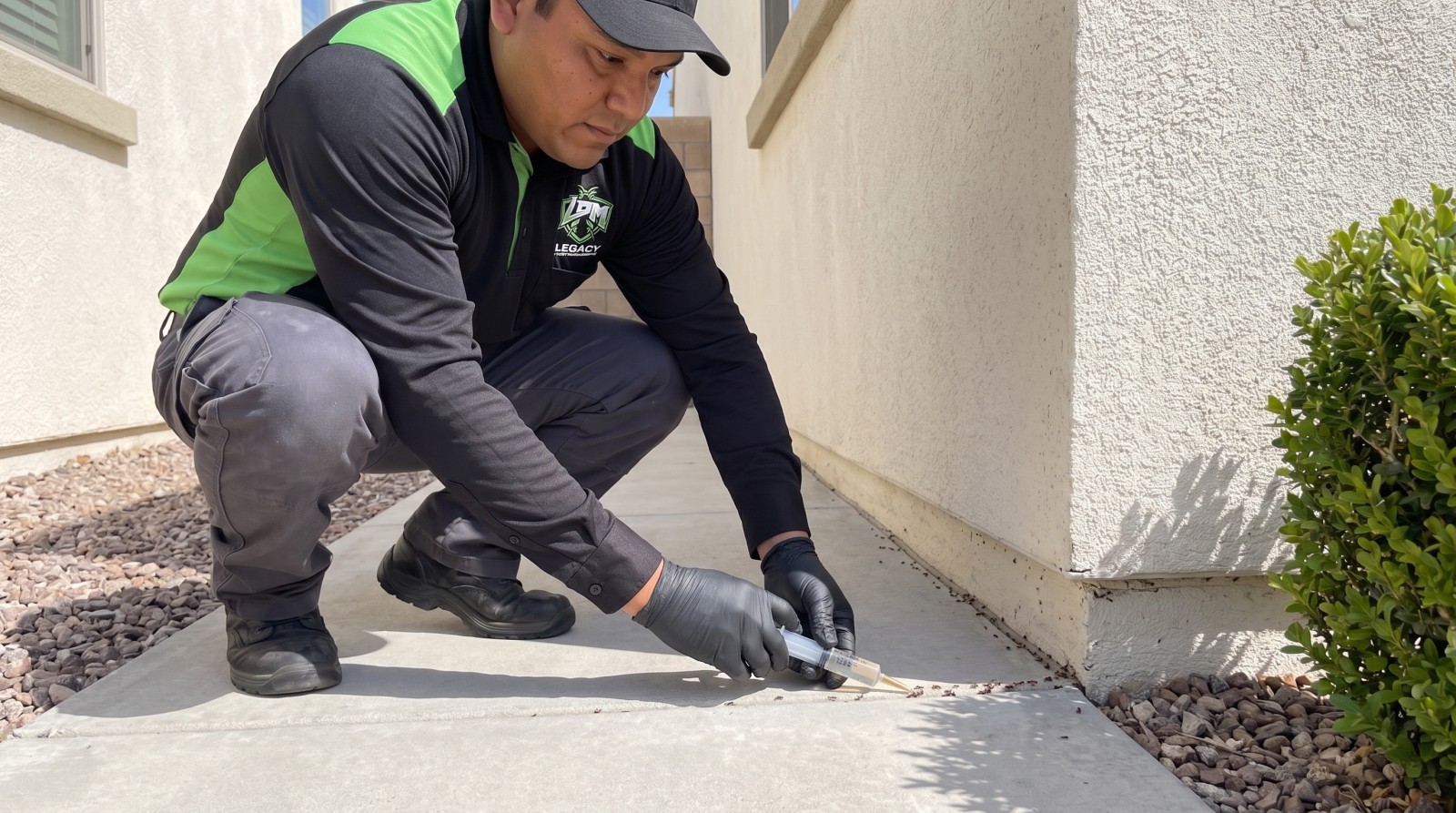
Ants are the most common pest call in San Diego County, and the reason they are so persistent is not that people are doing anything wrong. It is that the dominant species here is built in a way that defeats the obvious response.
Call 619-277-4796 and tell us where the trail is.
The Argentine ant is the most common ant in and around homes and gardens in California, and its structure is unusual. Instead of one nest with one queen, it forms supercolonies: many nests, many queens, and workers that move freely between them without fighting.
New colonies are not founded by a lone queen flying off to start again. They form by budding, where a mated queen simply walks to a new site accompanied by workers. There is no mating flight to interrupt and no single nest to destroy.
Nests are shallow, sitting just below the soil surface, and go deeper in dry conditions. The colony has a narrow tolerance for heat and moisture, so rather than endure bad conditions it relocates. That last point is the one that explains almost everything about the way they behave around buildings.
December to March. Roughly three quarters of San Diego's rain falls in this window. Saturated soil drives the colony itself into wall voids, slab edges and structural gaps. Winter trails tend to be heavier and harder to clear, because what you have is a relocated nest rather than a foraging line.
August and September. The reverse. With the ground dry, ants come indoors for water and concentrate at sinks, tubs, dishwashers and toilets rather than at the pantry.
Research on ants in homes has measured both peaks, with the larger one in cold wet weather and a smaller one in hot dry weather. It matches what we see. Telling them apart matters because a water-seeking summer trail and a relocated winter nest need different work.
A perimeter spray kills foraging workers. Foragers are a small, replaceable fraction of a colony that has many queens spread across many nests, so the trail rebuilds. That is not a failure of the product; it is a mismatch between the method and the animal.
Bait works differently. Workers carry it back and share it through the colony, which is the only route that reaches the queens.
We are not going to tell you sprays are useless, because university field trials have measured substantial reductions in ant activity from treated perimeters. What the same work shows is that combining a perimeter application with gel and granular bait performed better than either alone, holding reductions of more than 88 percent for at least eight weeks. Bait-led, with a perimeter component where it helps, is what the evidence supports.
One claim we will not repeat: you will read that spraying causes colonies to split or bud in response. We looked for support for that and could not find any for this species. It gets repeated a great deal and we would rather leave it out than pass on something we cannot stand behind.
Since 2012 California has restricted where pyrethroids can be applied around structures, because urban runoff was carrying them into waterways. For professional applicators that means no application during rain, none onto surfaces with standing water, and nothing into gutters, storm drains, drainage grates or dry creek beds at any time. On driveways, patios and sidewalks only narrow crack-and-crevice work or small spot treatments are permitted, and perimeter bands on walls are limited to the first two feet above grade.
So a bait-led program is not just better biology, it is what the current rules are shaped around. Anyone describing a broad perimeter spray as their whole approach is describing something narrower than it used to be.
Argentine ants dominate, but not exclusively. Odorous house ants, pavement ants, southern fire ants, Pharaoh ants, harvester ants and carpenter ants all turn up in California homes and not all of them respond to the same bait. Carpenter ants in particular are a structural question rather than a nuisance one, because they excavate wood to nest.
Identification is quick and it changes the plan, so it is worth doing rather than assuming.
Expected. The spray removes the workers you can see and leaves the queens untouched, so the trail rebuilds. Bait that gets carried into the nest is what changes the outcome.
Not while bait is down, because you will remove the ants that are carrying it. Once the program has worked, wiping trails removes the chemical trail markers they follow.
In late summer that usually means water rather than food. In winter it more often means a nest has moved into a wall or slab edge near the plumbing.
It can. Honeydew from aphids, scale and mealybugs is a major food source, and ants actively protect those insects. Dealing with them removes part of the reason the ants are there.
Winged ants are reproductives, and they are easy to confuse with termite swarmers. Ants have a narrow waist and unequal wing pairs; termites have a straight-sided body and four wings of equal length. If you are unsure, keep one and we will identify it.
Ant Control is part of our General Pest Control program, and commonly overlaps with these:
We run ant control from both offices. See El Cajon or San Diego for the communities each one covers, or browse the full list of service areas. You can also send us a request, or read more about Legacy Pest Management.
Call 619-277-4796 or send a request and tell us what you are dealing with. We will recommend a plan that fits the property rather than a default package. We are open 24 hours a day, seven days a week.
Get Started
Tell us what you are seeing and where it is happening. You will get an honest assessment of the problem, what it takes to solve it, and whether your property needs ongoing service or a single visit. Pest, wildlife and termite work across San Diego County.