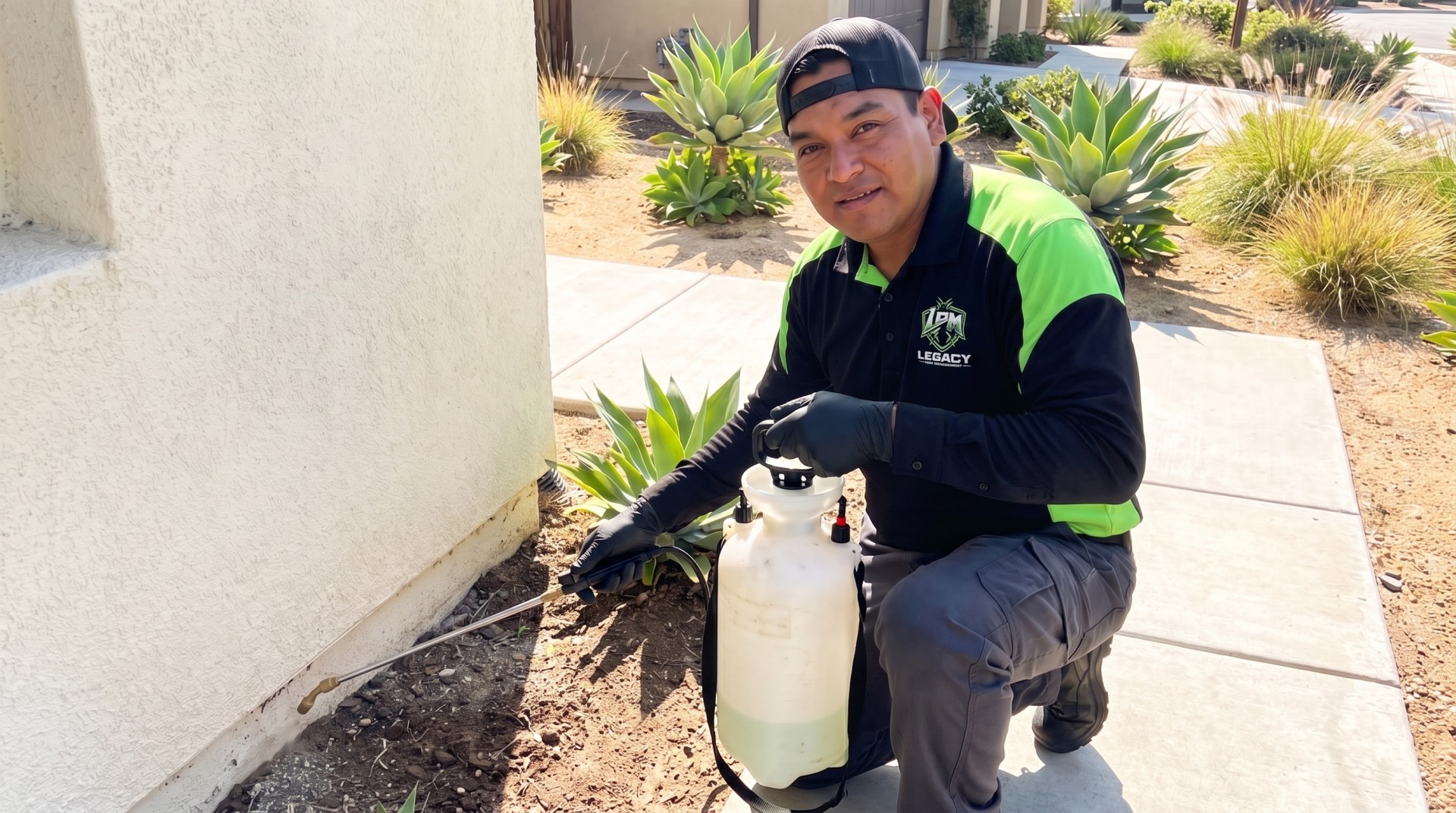
Most homes in San Diego County do not have a pest problem so much as a pest season. The same handful of conditions repeat, and they repeat on a schedule that follows the weather rather than anything happening indoors.
Roughly three quarters of the year's rain falls between December and March. June through August is effectively dry. That single split explains most of what we are called out for.
Call 619-277-4796 and tell us what you are seeing and where.
Argentine ants are the dominant nuisance ant in coastal California and the most common residential call we take. They nest shallowly, just below the soil surface, and they tolerate only a narrow band of warmth and moisture, so when conditions move outside it they relocate rather than wait.
That produces two quite different problems in the same house.
December to March. Rain saturates the shallow nests and the colony itself moves into wall voids and slab edges. Winter trails are usually heavier and harder to clear than summer ones, because you are dealing with a relocated nest rather than a foraging line.
August and September. The reverse. With the ground dry, ants come indoors looking for water and concentrate at sinks, tubs, dishwashers and toilets rather than at food.
Knowing which of the two you have changes the treatment. A winter nest in a wall needs something different from a summer water-seeking trail.
Argentine ants form supercolonies with many queens spread across many nests. A perimeter spray kills the workers on the trail without touching the queens, so the trail rebuilds within weeks. Bait carried back into the nest is what actually reduces the population.
We are not going to tell you sprays do nothing, because that is not true either. University trials have measured substantial reductions from perimeter applications. What the same work shows is that bait and perimeter together outperform either on its own, and that spray alone is treating the symptom.
There is also a regulatory reason the industry moved this way. Since 2012 California has restricted where pyrethroids may be applied around structures: no application during rain, none to surfaces with standing water, nothing into gutters, storm drains or drainage grates, and on hard surfaces only narrow crack-and-crevice or small spot treatments. Perimeter bands on walls are limited to the first two feet above grade. A bait-led program is not a preference, it is what the rules and the biology both point at.
The County of San Diego identifies the roof rat as the most common rat in the county and notes it climbs rather than burrows. They nest in attics, wall voids and ceiling voids, travel along branches, fences and utility lines, and range up to 300 feet from a nest. Entry is usually high on the building. If something is in your ceiling, it almost certainly did not come in at ground level.
What matters here is which one. German cockroaches breed indoors and are a genuine infestation. The outdoor species that wander in from meter boxes and irrigation boxes looking for water do not establish inside, and people usually find them dead. Those are two different jobs and only one of them is in your kitchen.
Spiders follow the insects they eat, so reducing the insect population reduces them. Black widows are the medically significant spider in California and they favor garages, sheds, woodpiles and meter boxes rather than living space.
Different service, but we look while we are there. Six-sided pellets and small kick-out holes in above-ground wood point to drywood termites; mud tubes running up a foundation point to subterranean.
A pre-1940 wood-framed house has vented attics, open eave lines and often a raised foundation with a crawl space. That is drywood termite and roof rat territory, and entry tends to be high or underneath.
A 1950s to 1970s slab tract house is a different animal. The weak points are the weep screed, expansion joints, utility penetrations and a settled slab edge, and the pests that exploit them are ants and subterranean termites.
Newer construction is tighter, and the problems concentrate at irrigation and meter boxes, garage seals and landscaping pressed against the wall.
Tell us roughly when the house was built and we will know where to look first.
Product choice and placement are part of the plan rather than an afterthought. We will talk through what is being used and where before anything is applied. If anyone in the household has a specific sensitivity, or you would rather we work exterior-only, say so when you call and we will scope it that way.
Expected against a supercolony. The spray removes the foragers you can see and leaves the queens untouched, so the trail rebuilds. Bait that gets carried into the nest is what changes it.
Not necessarily. The two peaks have different causes, and if you only ever get one of them a seasonal approach may be enough. We would rather scope it to what your property actually gets.
In late summer that is usually water-seeking rather than a nest nearby. In winter it more often means a colony has relocated into a wall or slab edge close to the plumbing.
For a single isolated problem, sometimes. For anything driven by conditions outside the building, one visit addresses what is there that day and not what keeps arriving.
Residential Pest Control commonly overlaps with these:
We run residential pest control from both offices. See El Cajon or San Diego for the communities each one covers, or browse the full list of service areas. You can also send us a request, or read more about Legacy Pest Management.
Call 619-277-4796 or send a request and tell us what you are dealing with. We will recommend a plan that fits the property rather than a default package. We are open 24 hours a day, seven days a week.

Get Started
Tell us what you are seeing and where it is happening. You will get an honest assessment of the problem, what it takes to solve it, and whether your property needs ongoing service or a single visit. Pest, wildlife and termite work across San Diego County.