Almost everything else on this site is downstream of this page. Rodents, raccoons, opossums, skunks, birds, and most of the ant and cockroach work too — the treatment handles what is already inside, and the sealing is what stops it happening again.
Call 619-277-4796 and tell us what has been getting in and where you have seen it. We are open 24 hours a day, seven days a week.
There is a piece of California law that quietly settles the whole argument.
Raccoons are furbearers and opossums and skunks are nongame mammals, and state regulations prohibit relocating any of them without written permission from the Department of Fish and Wildlife. A healthy animal that is trapped is released where it was caught, or humanely euthanized. Nobody can lawfully drive your raccoon to a nice canyon and let it go, whatever a website says.
Sit with that for a second. If the animal cannot be taken somewhere else, then catching it was never the thing that ended the problem. The opening it used is still there, and San Diego County has no shortage of animals looking for one.
Closing the building is the only step that actually finishes the job. That is not the premium option. It is the part that works.
UC is blunt about it: the most successful and longest-lasting strategy for rat control around structures is exclusion. Not bait. Not traps. Sealing.
This is also where the maintenance-plan question gets answered honestly. A house that has been properly closed up does not need somebody turning up every month to refill stations, because there is nothing coming in to feed on them. A house that has never been sealed needs that visit forever, which is exactly why some companies would rather sell the visit than the repair.
An exclusion inspection is a slow walk of the whole envelope, and the openings are almost always boring and specific.
The gap where a lower roof meets a wall, which is the classic raccoon route. Fascia boards that have softened and pulled away. Dislodged turbine and box vents. Soffit returns. Under a tile roof, the open ends of the tiles themselves.
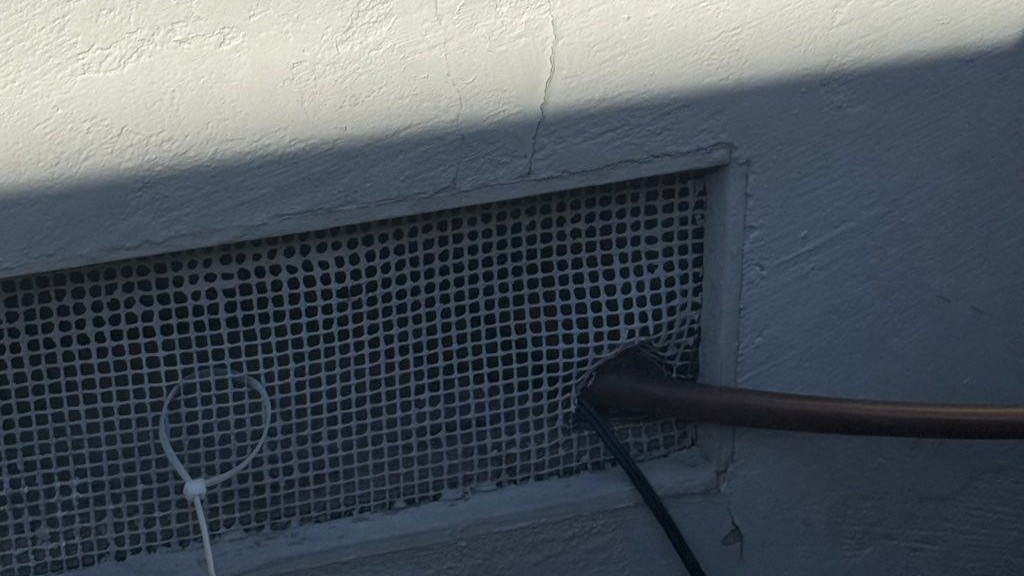
Foundation vents with rusted, torn or missing screens. Crawl space access doors that no longer sit square. The lattice skirt around a raised deck. The gap under a shed that has settled on soft ground. Where a utility line or gas pipe passes through the stem wall and the gap was never sealed properly.
Garage door bottom seals, which is one of the commonest rodent entries in San Diego County and one of the cheapest to fix. Dryer and bathroom vent terminations with broken flaps. Chimney tops without a cap. Weep screed and stucco that reaches the ground.
The number that governs almost all of it: a gap larger than a quarter of an inch is an entry point. A mouse gets through a hole slightly bigger than that, and a rat through anything it can fit its skull into.
Most of the exclusion work we are called in to fix is not a materials failure. It is an installation failure, or the wrong material in the first place.
Where an animal is still inside, a one-way door lets it leave under its own power and stops it coming back. No handling, no trap, no stress — and with a skunk, no discharge under your house.
The thing that gets skipped is checking for young first. Raccoon kits arrive around April and May. Skunk kits in spring. Opossums breed twice a year. Sealing an entry while dependent young are inside does not solve anything; it leaves animals in your ceiling that cannot get out, and the outcome is odour, flies, and a repair bill that dwarfs the original job.
So the inspection establishes whether young are present before anything is closed. Where they are, the work is staged around them.
Exclusion is not a spray, and it is not something that can be quoted over the phone from a photograph. It is carpentry and sheet metal work informed by knowing what the animal is capable of.
It also is not always the whole answer. A property backing onto canyon with heavy ongoing pressure may still want a service schedule after the sealing is done. The difference is that it will be a choice rather than a substitute for the repair.
Usually, up front. It is also the only version that ends. Trapping without sealing is an annual cost with no completion date, which is why some companies prefer it.
The roofline work is height work and the materials matter more than people expect. The commonest DIY outcome we are called to fix is a sealed entry with a second one still open, which achieves nothing, or an animal shut inside.
Properly fixed metal on a sound substrate lasts as long as the substrate does. What fails is mesh that was stapled on, or foam used as a barrier, or an edge that was never buried.
Talk to Jonathan about what is covered on your specific property. Blanket guarantees printed on a website are worth what you paid for them.
Yes. If what you have is one mouse that came in an open garage door, we will say so.
Exclusion is the backbone of Wildlife Removal — see Raccoon Control, Opossum Control, Skunk Control and Bird Control. It sits alongside Rodent Control, and pairs with Attic Insulation & Sanitation and Crawl Space Treatment where there is a mess to clear up underneath.
We handle exclusion work from both offices. See El Cajon or San Diego for the communities each covers, or browse the full list of service areas. You can also send us a request, or read more about Legacy Pest Management.
Tell us what you have been hearing or seeing, where, and roughly how long it has been going on. Photographs of the roofline and any gap you have found save a lot of time.
Get Started
Tell us what you are seeing and where it is happening. You will get an honest assessment of the problem, what it takes to solve it, and whether your property needs ongoing service or a single visit. Pest, wildlife and termite work across San Diego County.