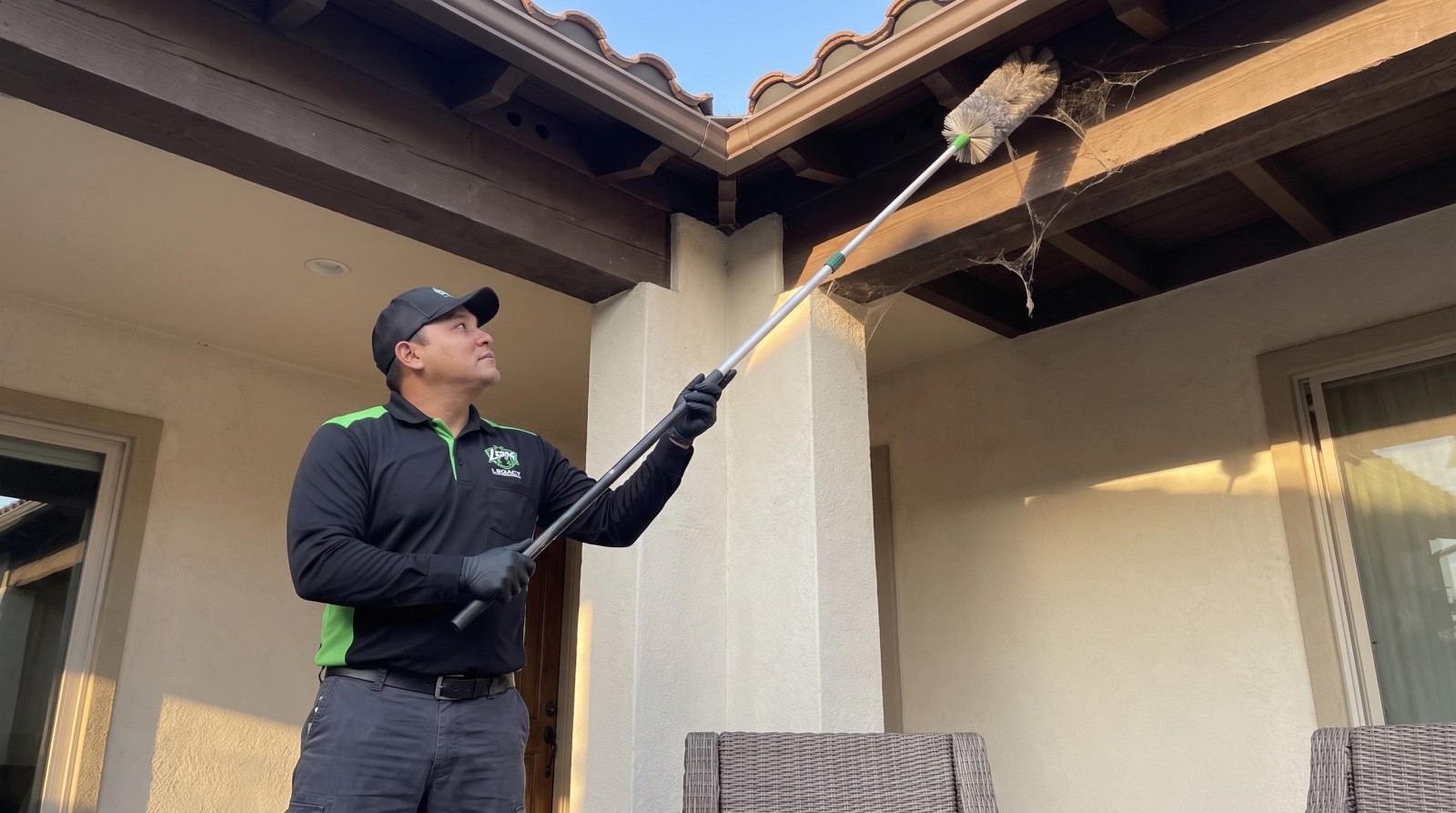
Most spider calls we take are about fear rather than damage, and a good part of our job is telling people accurately which spiders in San Diego County matter and which do not. There is one that genuinely warrants care. There is another that is enormously common and largely harmless. And there is a famous one that does not live here at all.
Call 619-277-4796 and tell us where you are finding them.
There are no brown recluse spider populations in California. That is UC's position, stated plainly: fewer than twenty verified specimens have been collected in the entire state over several decades.
This matters because brown recluse gets blamed for a great many things here. Most California cases diagnosed as recluse bites turn out to be bacterial infections, including MRSA, other arthropod bites, or unrelated medical conditions. If a pest control company offers to treat your home for brown recluse in San Diego, they are selling you something that is not there.
Two recluse species do occur in California. The desert recluse lives in the Sonoran and Mojave deserts, relevant only to the far eastern edge of the county. The Chilean recluse is confined to a very limited area of Los Angeles. Neither is a coastal or central San Diego problem.
The western black widow is the medically significant spider in California. The mature female is about half an inch long, shiny black, with a red hourglass on the underside of the abdomen, though appearance varies considerably. The egg sac is yellowish and teardrop-shaped.
They favor dark, dry, sheltered, relatively undisturbed places: garages, sheds, woodpiles, meter boxes, rock walls, stored materials, outdoor furniture that has not moved in a while. They are common in exactly those settings and remain common in garages and natural areas.
Two things worth holding at once. Black widows are genuinely worth respecting, and bites are rare even where the spiders are very common. People are most often bitten when they reach into a stored pile or pick up something that has been sitting undisturbed. Gloves and a look before you reach prevent most of it.
The brown widow arrived in Southern California around 2003 and is now established. It is mottled tan, brown and gray, with no red hourglass, and the reliable identifier is the egg sac, which is covered in small surface projections and looks a bit like an oversized pollen grain.
It is now far more abundant around homes than the black widow. One Southern California survey recorded 8.59 brown widows per collector-hour at residences against 0.42 western black widows, roughly a twenty-fold difference. They favor patios, playground equipment, the underside of outdoor furniture, railings, eaves and meter boxes.
Here is the part that gets stated backwards constantly: brown widow venom is less toxic than black widow venom, and brown widows inject very little. Documented bites have been minor, comparable to a non-toxic spider bite. You will read the opposite on a lot of pest control sites. It is wrong, and we are not going to repeat it to make a sale.
Notably, that same survey found neither species inside homes.
This is the single most useful thing to understand about spider control. Spiders are predators, and a property with a large spider population usually has a large insect population supporting it.
Treat the spiders alone and you have removed the predators while leaving the prey. Reduce the insects, and the spider population has less reason to stay. That is why spider work is usually part of a broader exterior program rather than a standalone spray.
The conditions that concentrate insects are the same ones that concentrate spiders: exterior lighting drawing insects at night, vegetation touching the structure, standing water, and clutter that provides shelter.
UC's recommendations for widow spiders are mostly mechanical rather than chemical, and that reflects how these spiders live:
Spiders are the reason most people call, but the same visit usually deals with everything else living in the same band around the outside of the house. These get lumped together as occasional invaders, and they behave as a group.
Field crickets come in from outside, usually at night and usually toward light. In a garage or a laundry room a single male can be audible through a wall for weeks. They do not breed indoors in any meaningful way, so the answer is almost never an interior spray — it is the door sweep, the garage seal, and moving or shielding the exterior light that is drawing them.
Two different situations get called the same thing.
Occasional invaders — ground beetles, darkling beetles and similar — wander in from mulch, leaf litter and irrigated planting beds against the foundation. Same fix as crickets: the gap, not the insect.
Stored product beetles — in flour, grain, pet food, birdseed and dried goods — are a different job entirely. Spraying the kitchen does nothing. The source is a package, and finding it is the work. It is very often birdseed or an old bag of flour at the back of a cupboard.
Then there are the beetles that show up after something else. Carpet beetles and larder beetles feed on animal material, so a sudden appearance in an upstairs room quite often means something died in the wall or a bird nest is being vacated in the eave above. Treating the beetles without finding that is why it comes back.
All of them are exterior insects with an interior symptom. Sealing gaps over a quarter of an inch, fixing door sweeps, pulling mulch and dense planting back from the foundation, and dealing with exterior lighting handles most of it permanently. That is the same work as Exclusion & Sealing, which is why it tends to get done at the same time.
Very unlikely in San Diego, because there are no populations here. If you have a wound that is not healing, that is a medical question rather than a pest control one, and worth seeing a doctor about rather than assuming a spider.
The egg sac is the giveaway. Black widow egg sacs are smooth and teardrop-shaped; brown widow egg sacs are covered in little spiky projections. The adult brown widow is mottled rather than glossy black.
Usually a food supply question. Exterior lighting draws insects to the same spots night after night, and the webs follow. Changing the lighting often does more than spraying the eaves.
Not necessarily. Most species here are harmless and are quietly reducing the insects around your home. The ones worth removing are the widows in places you reach into.
No. Broad spraying is poorly matched to how spiders live and to what actually reduces them. Mechanical removal, harborage reduction and dealing with the insect population do more.
Spider Control is part of our General Pest Control program, and commonly overlaps with these:
We run spider control from both offices. See El Cajon or San Diego for the communities each one covers, or browse the full list of service areas. You can also send us a request, or read more about Legacy Pest Management.
Call 619-277-4796 or send a request and tell us what you are dealing with. We will recommend a plan that fits the property rather than a default package. We are open 24 hours a day, seven days a week.

Get Started
Tell us what you are seeing and where it is happening. You will get an honest assessment of the problem, what it takes to solve it, and whether your property needs ongoing service or a single visit. Pest, wildlife and termite work across San Diego County.