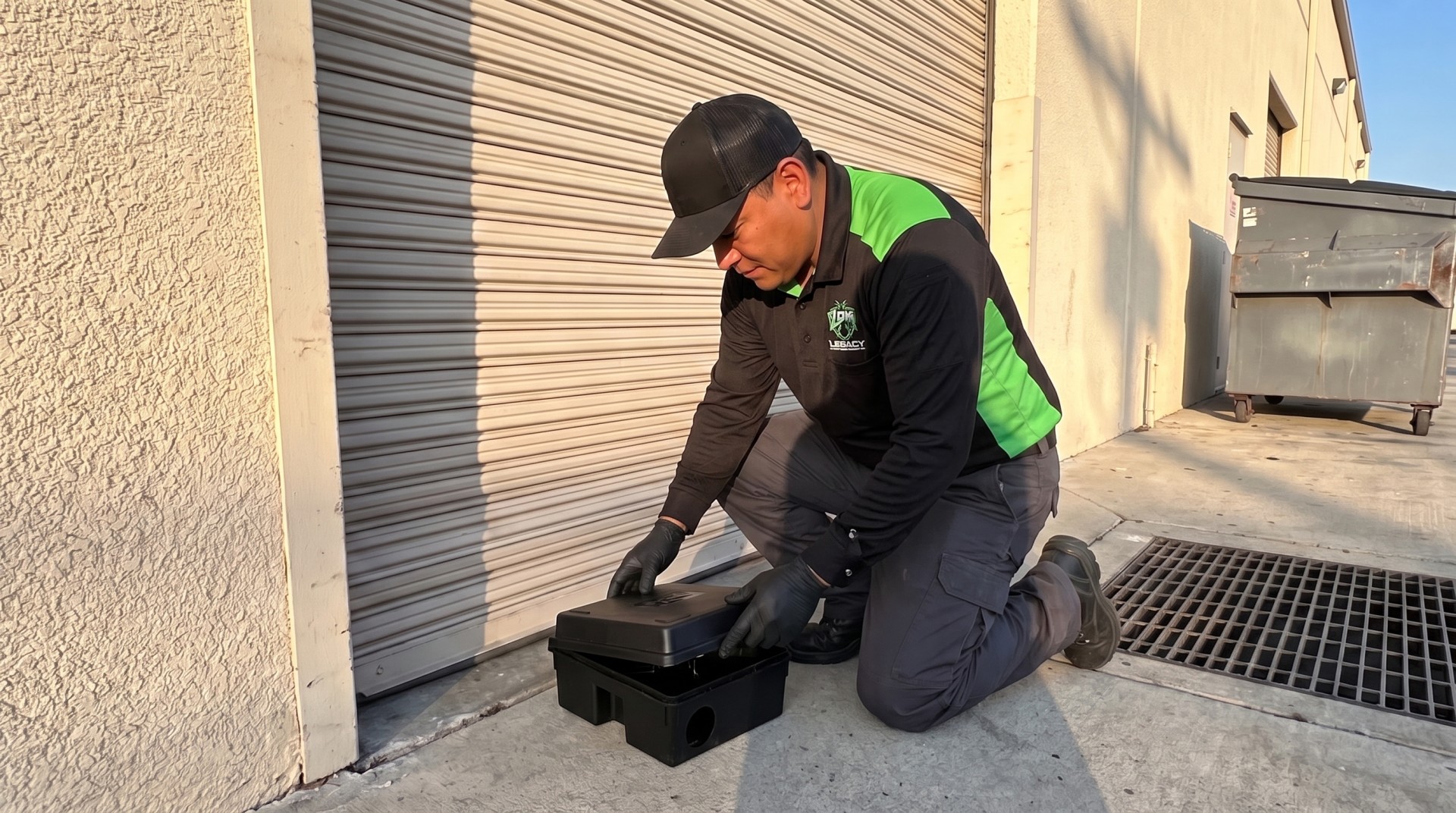
Commercial pest control is mostly a documentation and access problem wrapped around a biology problem. The insects are the same ones we deal with in houses. What changes is that the building is bigger, the kitchen runs on a schedule, several parties have to agree before work happens, and somebody needs a record of it afterwards.
Call 619-277-4796 and tell us what kind of premises you are running.
Restaurants, bars, cafes and commercial kitchens are the accounts where sanitation and structure do most of the work and treatment finishes it.
The German cockroach is the species that matters. It breeds indoors, prefers warm humid areas close to food and water, and a single female and her offspring can produce over 30,000 individuals in a year. That reproductive rate is why a small problem becomes a serious one quickly, and why monitoring beats reacting.
Practically, our attention goes to the back of house rather than the dining room: under and behind equipment, the line, dishwash, dry storage, floor drains, grease traps and the waste enclosure outside. Traps beside stoves and refrigerators catch far more than traps under sinks, which is a useful thing to know when you are trying to work out how bad something is.
American cockroaches are a different problem with a different fix. They live in sewers, storm drains and meter boxes and forage up into ground floors through damaged pipework and floor drains whose traps have dried out. If they are appearing in a ground-floor washroom and nowhere else, the treatment belongs outside and in the drain, not in the kitchen.
Apartment buildings, condos, converted duplexes and mixed-use properties share a specific problem, and there is good research on it.
A study of cockroach spread through a high-rise found infestations cluster in a very particular pattern: units across a hallway from one another, units sharing a wall on the same floor, and units stacked directly above and below. The routes are the shared kitchen and bathroom plumbing between neighbors and the vertical plumbing chases between floors.
In the same building, a coordinated program brought infestation down from about half the units to roughly one in eight over twelve months. Unit-by-unit treatment kept losing ground. After treatment the sideways spread pattern disappeared while the vertical one persisted longest.
The conclusion is not subtle: in a connected building, treating the unit that complained does not hold. If a property manager asks us to treat one apartment in an infested building, we will do it, and we will also tell them plainly what it will and will not achieve.
Offices and retail are usually lower-pressure and more about the perimeter, the loading area and the waste enclosure than about anything inside.
Lodging is its own category, because the driver is guest turnover rather than the building. Bed bugs travel with people and luggage. Around 85 percent of bed bugs are found in or immediately around the bed, which makes inspection focused and worth doing between guests rather than after a complaint. Adjacent rooms are worth checking when something is found.
Most commercial accounts need a record as much as they need a treatment. We can provide written documentation of what was found, what was applied, where, and what we recommend, in a form that works for a health inspection, a property management file, a board approval or a landlord conversation.
If you need a specific format or a particular level of detail for your own compliance requirements, tell us and we will match it.
Kitchens cannot be treated mid-service and shops do not want us in the aisles at midday. Tell us the window that works and we will schedule around it, including outside business hours where that is what the job needs.
For multi-tenant buildings, coordinated access across several units on the same visit is usually the difference between a program that works and a series of visits that do not.
We can, and in a connected building it usually will not hold. The population lives in the shared plumbing route. Treating the affected units together costs less over a year than treating complaints one at a time.
Yes. Tell us the window and we will work to it.
We can provide written records of what was found, applied and recommended for each visit.
That pattern usually points to a drain rather than an infestation inside the building. A floor drain or unused fixture whose trap has dried out gives sewer-dwelling species a direct route in.
It depends on the premises, the volume and what we find at survey. We would rather set the frequency from the site than quote a default.
Commercial Pest Control commonly overlaps with these:
We run commercial pest control from both offices. See El Cajon or San Diego for the communities each one covers, or browse the full list of service areas. You can also send us a request, or read more about Legacy Pest Management.
Call 619-277-4796 or send a request and tell us what you are dealing with. We will recommend a plan that fits the property rather than a default package. We are open 24 hours a day, seven days a week.
Get Started
Tell us what you are seeing and where it is happening. You will get an honest assessment of the problem, what it takes to solve it, and whether your property needs ongoing service or a single visit. Pest, wildlife and termite work across San Diego County.