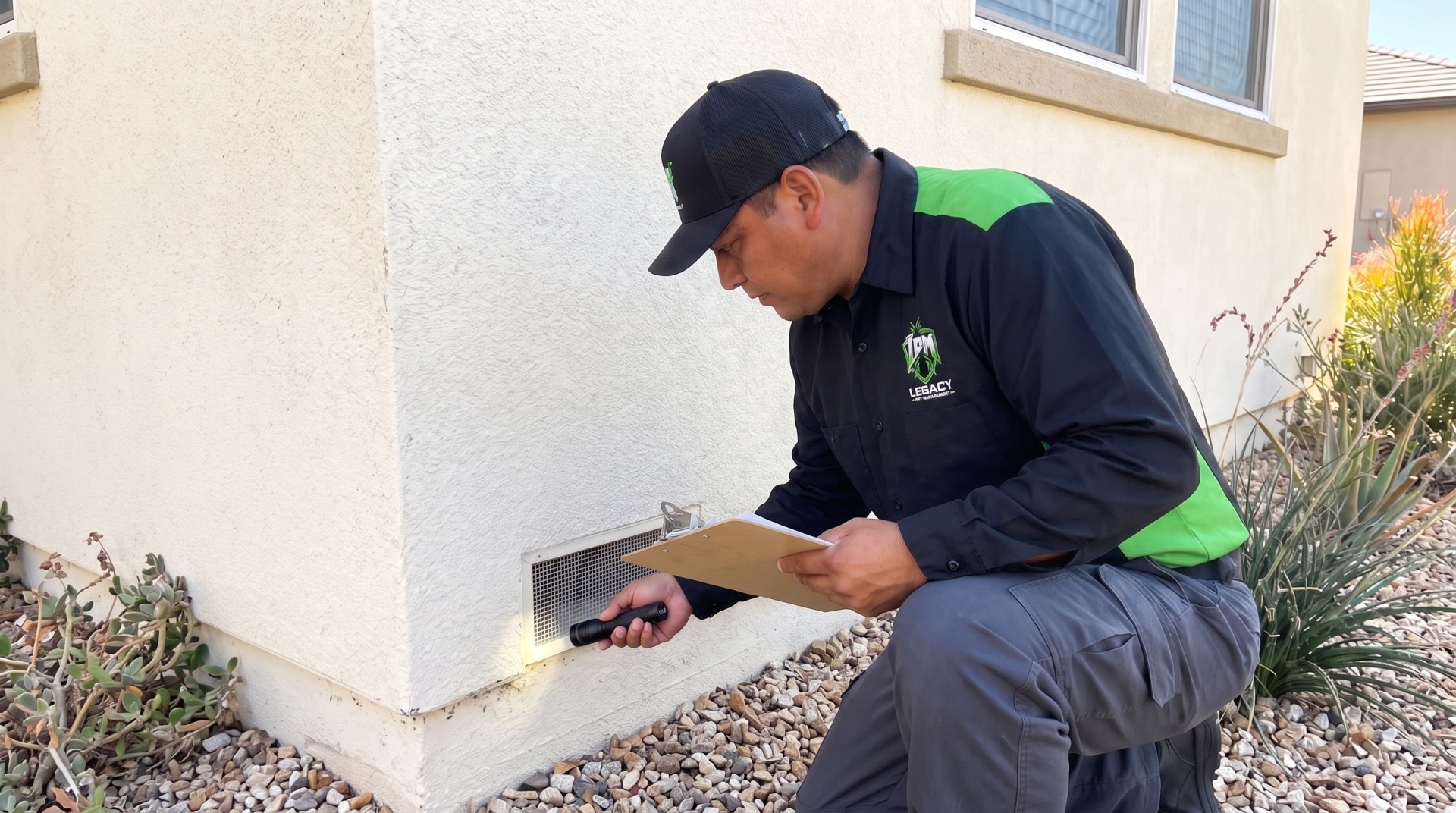
Sometimes the useful thing is not a treatment but an answer. A pest inspection is a documented walk of the property to establish what you actually have, how it is getting in, and what conditions are keeping it there.
Call 619-277-4796 to arrange one. We are open 24 hours a day, seven days a week.
The perimeter and foundation line, grade and drainage, irrigation, vegetation touching the structure, woodpiles and stored materials, meter and irrigation boxes, and the roofline. On most properties the answer is out here.
Gaps at the roofline, unscreened or damaged vents, utility penetrations, weep screeds, door thresholds and garage seals. Rodents can pass under a half-inch gap, and sealing anything over a quarter inch is what excludes mice as well.
Kitchens, bathrooms, laundry, plumbing voids and any area the activity has been reported. In shared-wall buildings that includes how the units connect, because that is usually how the problem travels.
Crawl space and attic where accessible: moisture, wood-to-soil contact, insulation disturbance, droppings, and evidence of nesting or wood-destroying activity.
Several pairs get confused routinely, and getting them the wrong way round wastes the treatment:
A clear account of what was found, where, and what we would recommend, in writing if you need it for records or for a conversation with a landlord, buyer or board. If the honest answer is that no treatment is needed, that is what the report will say.
A commercial or multi-unit inspection asks a different question from a residential one. On a single-family house we are establishing what is present and how it got in. In a connected building we are also mapping how far it can travel.
That means looking at the shared routes rather than only the unit that reported something: the plumbing walls between neighboring units, the vertical chases that connect floors, shared laundry and refuse areas, and the roof and basement levels that link everything. Cockroaches in particular cluster along those routes rather than spreading evenly, so an inspection that only covers the complaining unit will usually understate the problem.
For food premises the priority shifts again, to the back of house: under and behind equipment, floor drains, grease traps, dry storage and the waste enclosure outside. And for any commercial account the written record is often as important as the findings, because it is what a health inspection, a board approval or a management file actually needs.
Where several units need access on the same visit, tell us at booking. Coordinating that once is usually the difference between a useful inspection and three partial ones.
Worth saying plainly, because it affects how you should read any report, including ours.
No inspection sees inside every wall, void and sealed cavity. What it covers is what can be reached and observed on the day. Where a crawl space is inaccessible, an attic is blocked, or a wall cannot be opened, that is a limit on the finding rather than evidence of absence, and a report that does not say so is not being straight with you.
A clear inspection is also a snapshot. It tells you what was present at that point, not what will be present in a year, and it is not a guarantee against something arriving later.
What it does do well is establish species, locate entry points and conditions, and give you a documented basis for a decision. On an older property, or one you are about to buy, that is usually the thing worth having.
No. A termite inspection is a focused evaluation for wood-destroying organisms. A general pest inspection covers the wider picture, including rodents, insects and entry conditions. If you specifically need termite work, start with Termite Inspections.
Yes. A lot of inspections are precautionary, particularly on older properties or where a neighbor has had a problem.
No. The inspection stands on its own. If nothing needs doing we will tell you.
Not reliably. Droppings, sound and entry evidence narrow it down, but access is what settles it. Where access is unsafe or blocked we will say so rather than guess.
We run pest inspections from both offices. See El Cajon or San Diego for the communities each one covers, or browse the full list of service areas. You can also send us a request, or read more about Legacy Pest Management.
Call 619-277-4796 or send a request and tell us what you are dealing with. We will recommend a plan that fits the property rather than a default package.
Get Started
Tell us what you are seeing and where it is happening. You will get an honest assessment of the problem, what it takes to solve it, and whether your property needs ongoing service or a single visit. Pest, wildlife and termite work across San Diego County.