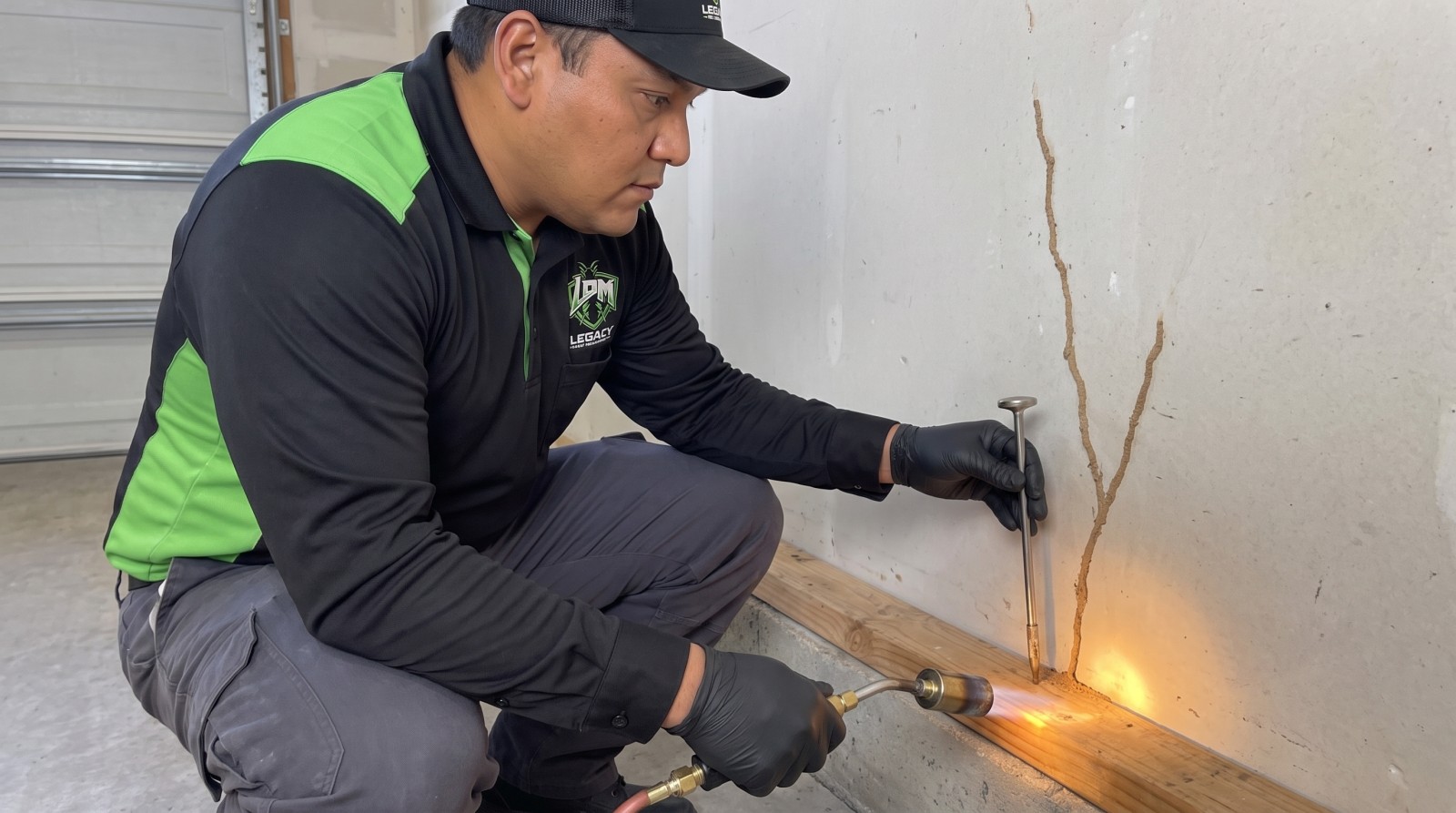
A termite inspection exists to answer one question before anyone spends money on treatment: which termite is it? San Diego County has two that matter, they live completely differently, and they are not treated the same way. Guessing wrong wastes the job.
Call 619-277-4796 to arrange an inspection.
The western drywood termite nests inside the wood itself and needs no contact with soil at all. That is why it turns up in places a soil treatment could never reach: attic sheathing and rafters, fascia, eaves, window and door frames, trim and siding.
Colonies are small, usually fewer than a thousand insects, and they mature slowly over years. A single structure can hold several separate colonies at once, and an infestation found today may well have started five or ten years ago.
What you can actually see: fecal pellets with six flat sides, which nothing else produces, pushed out through kick-out holes under two millimeters across.
The western subterranean termite needs soil contact and moisture, and maintains a connection to the ground. Statewide, UC identifies subterranean termites as California's most destructive termite, and they occur in nearly every region of the state.
What you can actually see: mud shelter tubes running up a foundation, a pier or through a crawl space. Damage follows the wood grain and is contaminated with soil, which looks quite different from the clean galleries drywood termites leave.
They are favored by wood in direct contact with soil, damp crawl spaces, leaking plumbing and poor drainage. The general benchmark is keeping structural wood at least twelve inches clear of soil.
If you have found a small pile of what looks like coffee grounds or sawdust, sweep it up and check the same spot again a few days later.
Fresh pellets mean the colony above is active. No new pellets suggests old activity. That single step tells us a great deal before the inspection starts, and it costs nothing.
Where access is unsafe or blocked, we will tell you that rather than guess. An honest note about what could not be reached is more useful than a report that implies the whole structure was seen.
Worth knowing, and worth keeping in proportion. In February 1992 the Formosan subterranean termite was found in La Mesa, the first non-native termite established in California. The eradication program lost its funding in 1997 and the same population was confirmed again in 2018, about a third of a mile from the original site.
Every confirmed colony in the published record sits within a very small area, and UC's own language is that it remains restricted to a small pocket. Most La Mesa homes will never encounter one, and the overwhelming majority of termite work anywhere in this county is ordinary drywood and western subterranean work.
What it does change is one practical thing. Formosan swarmers fly at dusk and are drawn to lights, roughly late May to early August. Our native subterranean termites swarm in daylight, on clear afternoons after rain. An evening swarm around a porch light in early summer is worth identifying rather than assuming, and it is the reason we identify species rather than guess.
Six-sided pellets and small kick-out holes in above-ground wood point to drywood. Mud tubes on a foundation point to subterranean. If you have both, that is possible too.
Yes. Stucco is a finish over wood framing. Drywood termites live inside that framing without ever touching soil, so the stucco hides the evidence rather than preventing the problem.
Colonies mature slowly and stay concealed while they do, so absence of evidence is not evidence of absence. Age and exposed wood are the two factors that matter most.
No inspection can see inside every wall and void, and we will not pretend otherwise. What it does is establish what is present where it can be reached, identify the species, and record the conditions that make recurrence likely.
Termite Inspections is one half of our Termite Control service. The inspection settles which species and how far it has gone; the treatment follows from that.
Termite Inspections commonly overlaps with these:
We run termite inspections from both offices. See El Cajon or San Diego for the communities each one covers, or browse the full list of service areas. You can also send us a request, or read more about Legacy Pest Management.
Call 619-277-4796 or send a request and tell us what you are dealing with. We will recommend a plan that fits the property rather than a default package. We are open 24 hours a day, seven days a week.
Get Started
Tell us what you are seeing and where it is happening. You will get an honest assessment of the problem, what it takes to solve it, and whether your property needs ongoing service or a single visit. Pest, wildlife and termite work across San Diego County.