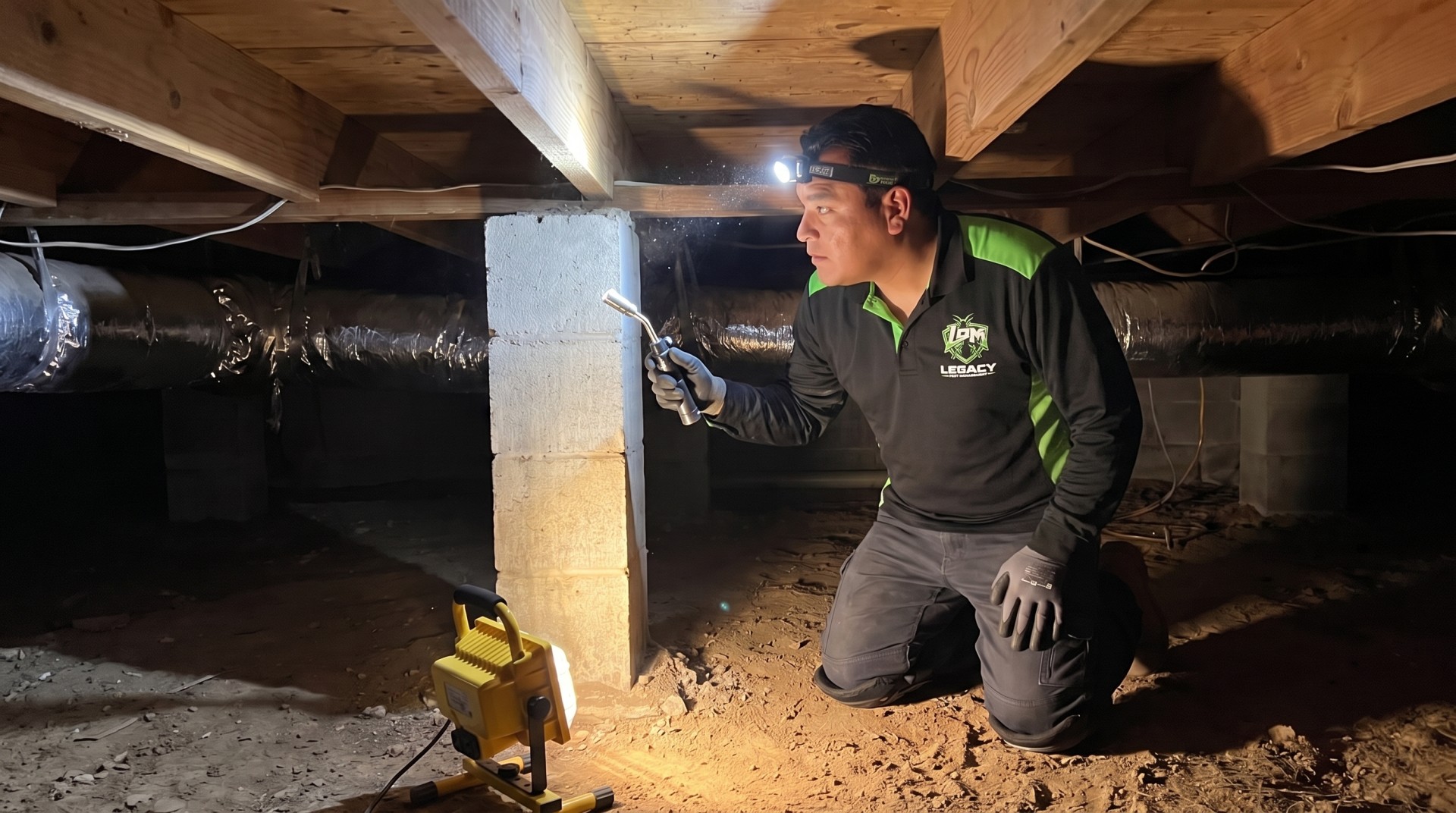
The crawl space is where most of a house's pest problems either start or become visible. It is also where the conditions that cause them sit, in plain sight, usually for years before anyone looks.
Call 619-277-4796 and tell us what you have noticed and whether anyone has been under there recently. We are open 24 hours a day, seven days a week.
Reticulitermes is the most destructive termite in California and it nests in soil, not in wood. It reaches your framing either through wood that touches the ground, or by building earthen shelter tubes up the foundation to bridge the gap.
Those tubes are the single most useful thing in a crawl space. They are made of soil, saliva and wood, and they exist because the colony has to stay connected to soil moisture. Finding them tells you there is an active route; finding the type tells you more. A working tube runs from soil to wood. An exploratory tube rises and connects to nothing. A drop tube comes down from wood back to the soil.
Worth knowing: fumigation does not treat subterranean termites. Tenting is a drywood termite remedy. The colony here is at or below ground level, out of reach of gas. Anyone quoting a tent for a crawl space finding is selling the wrong treatment.
Foundation vents with failed screens and a crawl space hatch that no longer sits square are two of the commonest rodent entries on a San Diego County house. Rats chew through plastic, foam, wood and caulk, so the fix is metal or it is not a fix.
The commonest ant in California nests shallowly, next to buildings, and moves indoors looking for water in dry weather or dry ground in wet weather. A dripping hose bib or a leaking supply line under the floor will hold a colony there indefinitely.
Dark, dry, sheltered and undisturbed describes a crawl space precisely, and it is where we most often find them on a residential property.
One correction while we are here: the brown recluse does not live in California. There are no breeding populations in the state. If a company has told you that you have brown recluse, they are wrong.
Usually called dry rot, which is a genuinely misleading name, because wood has to be wet for decay to happen. It may dry out afterwards. The species that matters most in buildings is a water-conducting fungus that can carry its own moisture along strands and keep decaying wood that looks dry.
Two figures get mixed up constantly and the difference matters when someone is quoting you for repairs.
So a meter reading of 22 percent is a condition worth correcting, not proof of active decay. And existing decay stops progressing once the wood dries below the threshold — which means damage found in a crawl space is not automatically a live problem requiring replacement.
California requires under-floor ventilation of at least one square foot of net free opening for every 150 square feet of crawl space, with an opening within three feet of each external corner. Install a proper ground vapour retarder and the required ventilation drops to one square foot per 1,500 — a ninety percent reduction, which is the point of the barrier.
Code also expects clearance: naturally durable or treated wood is required where joists sit closer than 18 inches, or girders closer than 12 inches, to the exposed ground.
Do not let anyone seal your foundation vents. Closing vents without converting the crawl space to a compliant unvented assembly — continuous vapour retarder, sealed seams, and a mechanical drying method — is a code violation and a moisture trap.
Encapsulation is a real technique and it solves real problems. It is also a humid-climate remedy being sold hard in a climate that is not humid.
Department of Energy research is specific about this. Closed crawl spaces showed clear benefits in the humid South. In the dry climates of the western United States, the finding was that both vented and closed crawl spaces performed adequately for humidity and energy, provided ducts were not in the crawl space. San Diego County is classified hot-dry, receiving under twenty inches of rain a year.
So encapsulation here is justifiable for specific reasons: HVAC ducts or an air handler in the crawl space, a persistent drainage or groundwater problem, or a comfort and duct-leakage objective. It is not justified as a default moisture cure the way it is in the Carolinas. If somebody is selling you one in El Cajon without naming which of those applies to your house, ask them which.
Worth being precise, because this is where a lot of money changes hands on vague authority.
A Branch 3 structural pest control licence covers wood-destroying organisms, and fungus and dry rot are a standard reportable category on the state inspection report. So the decay that damages your framing, and the repairs to it, are genuinely inside our scope.
Mold is not. California issues no licence or certification for mold assessment or remediation at all — there is no such credential in this state. We are not going to present ourselves as certified mold remediators, because nobody in California can be.
We are also not going to sell you air testing. The EPA position is that where visible growth is present, sampling is usually unnecessary, and the state health department is blunter: measuring molds does not tell you whether there is a health problem, and there are no established unhealthy levels to compare against. Find the water, fix the water, remove the material.
Not worried. It is worth looking, particularly if the house is older, if there has been a plumbing leak, or if you are hearing anything under the floor.
It usually means moisture, and moisture is worth chasing to its source. It does not automatically mean decay or an expensive job.
If the ground is bare soil, yes, and it earns its cost twice by reducing the ventilation the code requires. If there is one already and it is intact, you do not need it replaced with a thicker one.
Not necessarily, and this is exactly the sort of thing that gets over-called. A tube can be abandoned. We will tell you what we can and cannot establish from what is visible.
Crawl space findings usually lead to Termite Inspections and Termite Treatment, to Rodent Control and Exclusion & Sealing, or to Ant Control and Spider Control. For a sale or refinance, see Real Estate Inspection Reports.
We work under houses across the county from both offices. See El Cajon or San Diego for the communities each covers, or browse the full list of service areas. You can also send us a request, or read more about Legacy Pest Management.
Tell us the age of the house, whether there is a known leak, and what you have been seeing or smelling. If someone has already given you a crawl space quote, bring it — we will tell you plainly which parts of it are necessary.
Get Started
Tell us what you are seeing and where it is happening. You will get an honest assessment of the problem, what it takes to solve it, and whether your property needs ongoing service or a single visit. Pest, wildlife and termite work across San Diego County.