Opossums are the animal people are most often wrong about. They are blamed for damage they did not do, credited with eating every tick in the county, and occasionally treated as a menace. What they usually are is a slow, solitary marsupial that found a dry gap under your deck and took it.
The work is still worth doing properly, because an opossum under a structure brings fleas with it and because the space it found will be used again by something else if it stays open. Wildlife Removal handles it the same way as the rest: get the animal out, then close the building.
Opossums do not dig much and they do not build. They occupy. UC lists the usual spots plainly: under steps, porches, decks and tool sheds, and where there is access, in attics, garages and beneath houses. The nest is untidy, made from whatever was nearby.
They are not territorial in the way raccoons are, and an individual may use several dens across a small area rather than settling in one. That is why an opossum problem sometimes appears to solve itself for a week and then returns.
The signs are a flattened path to an opening, a smell that is musky rather than sharp, and often the animal itself, seen at dusk and moving without much urgency.
Opossums breed twice annually in California, roughly January to February and again June to July, with around seven young per litter.
The timing matters for the same reason it does with every other animal on this list. Newborns attach in the pouch for about eight weeks, leave it around eleven weeks, and are weaned near fourteen. For a stretch of each cycle the female is carrying young that cannot leave on their own, and part of that stretch she is denning somewhere dark and enclosed.
So the question before sealing is not only whether an animal is inside, but whether it is a female with dependent young. Sealing on the assumption that one animal walked in and one animal will walk out is how people end up with a problem they cannot see.
The genuine health consideration with opossums is not the animal. It is what it carries. Opossums are frequent hosts for fleas and ticks, and the flea question is the one that matters around homes with pets.
Flea-borne typhus has been rising across Southern California, and the reporting on it has been heavy enough that a lot of pest control copy now treats it as a countywide emergency. That is not accurate here. The increase has been concentrated in Los Angeles and Orange counties, and case numbers in San Diego County have remained low.
We would rather say that plainly than sell on a scare. What is true and useful: an opossum denning under a structure brings fleas onto the property, those fleas do not stay under the deck, and if you have pets the sensible pairing is the exclusion work plus Flea & Tick Treatment rather than one or the other.
Confirming the den is empty comes before closing it. The standard method is unglamorous and works: a thin layer of flour at the entrance, checked after dark, and tracks tell you which way the animal went. Where the situation is less clear, one-way doors let an animal leave and not return.
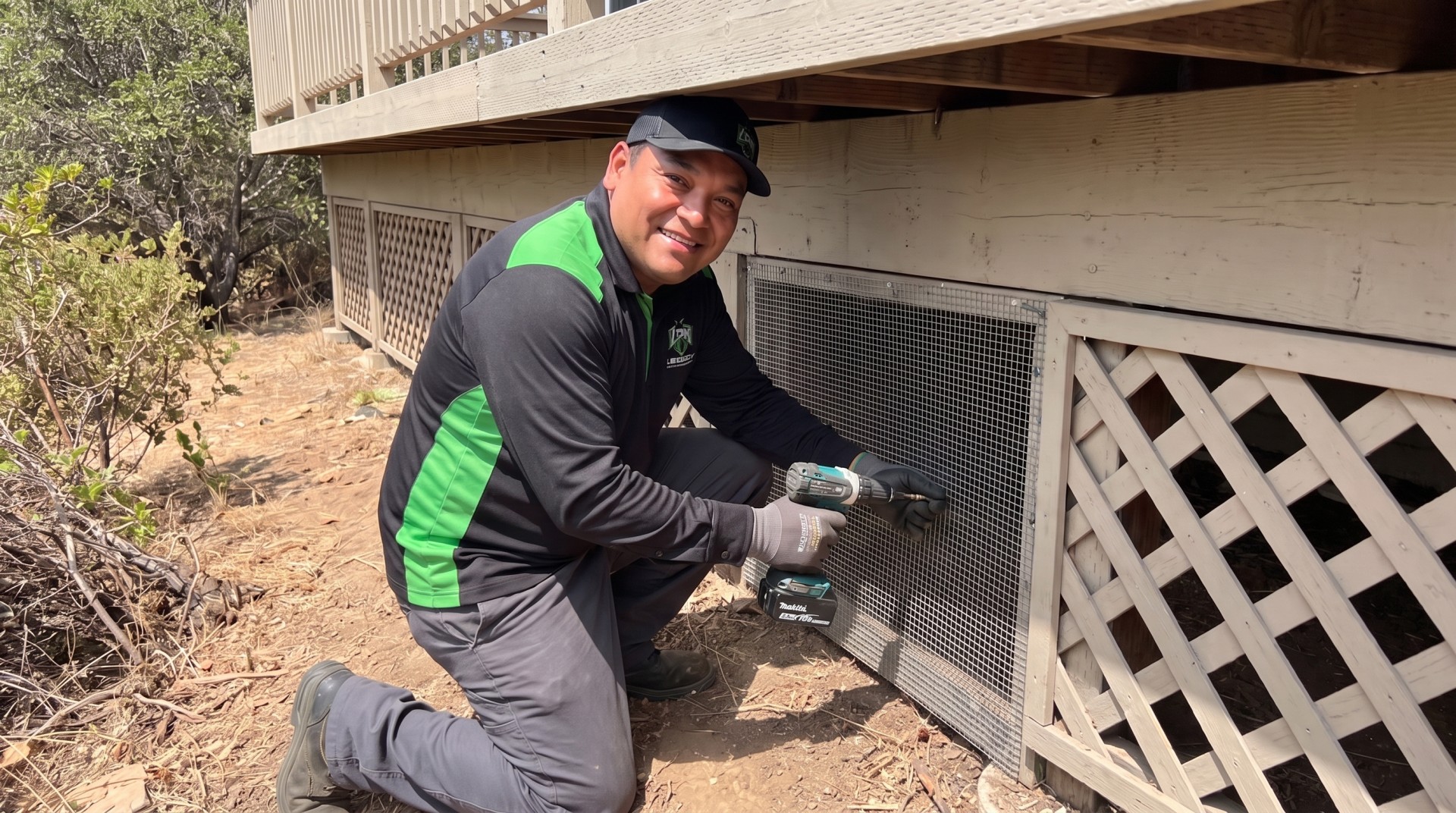
Then the sealing. Quarter-inch hardware cloth is the material for under-structure work, carried down and buried where the ground allows, because a gap that is merely covered is a gap that gets pushed at.
The commonest openings on San Diego County properties are the lattice skirt around a raised deck, a foundation vent that has lost its screen, the gap under a shed that has settled, and the crawl space door that no longer closes square.
Opossums are nongame mammals in California, and relocating them without written permission from the Department of Fish and Wildlife is prohibited. Local city or county rules can apply on top of that.
So nobody can lawfully promise to take your opossum to a nice field somewhere, and a healthy adult is released on site.
An animal that is injured, sick or orphaned is a different case, and a better one. Those can go to a permitted wildlife rehabilitation facility, which exists to get an animal back to health and back out into the wild. Opossum young are the common version of this, because a female may still be carrying dependent joeys when a den is opened, and they are not left to it.
Which is also why the part that solves the problem is closing the structure rather than removing the individual.
They would rather not engage, and the famous playing dead response is involuntary rather than tactical. But they have a lot of sharp teeth and a cornered opossum can injure a dog badly. Keep the dog off it and let it leave.
That claim came from a study whose numbers have since been questioned, and it gets repeated online as settled fact. Opossums do eat ticks. Whether they eat them in the quantities the internet says is not established.
If it is genuinely transient, no. If it is denning, the opening it is using will be found again by something else, and that is worth closing regardless.
Partly. Odour also comes from nesting material and waste left behind, so the cleanup is part of the job rather than an add-on.
Opossum work sits under Wildlife Removal, with Raccoon Control, Skunk Control and Bird Control. Where fleas have come indoors, pair it with Flea & Tick Treatment.
We handle opossum work from both offices. See El Cajon or San Diego for the communities each covers, or browse the full list of service areas. You can also send us a request, or read more about Legacy Pest Management.
Tell us where the animal is getting under, and whether you have pets on the property. Both change what we recommend.
Get Started
Tell us what you are seeing and where it is happening. You will get an honest assessment of the problem, what it takes to solve it, and whether your property needs ongoing service or a single visit. Pest, wildlife and termite work across San Diego County.