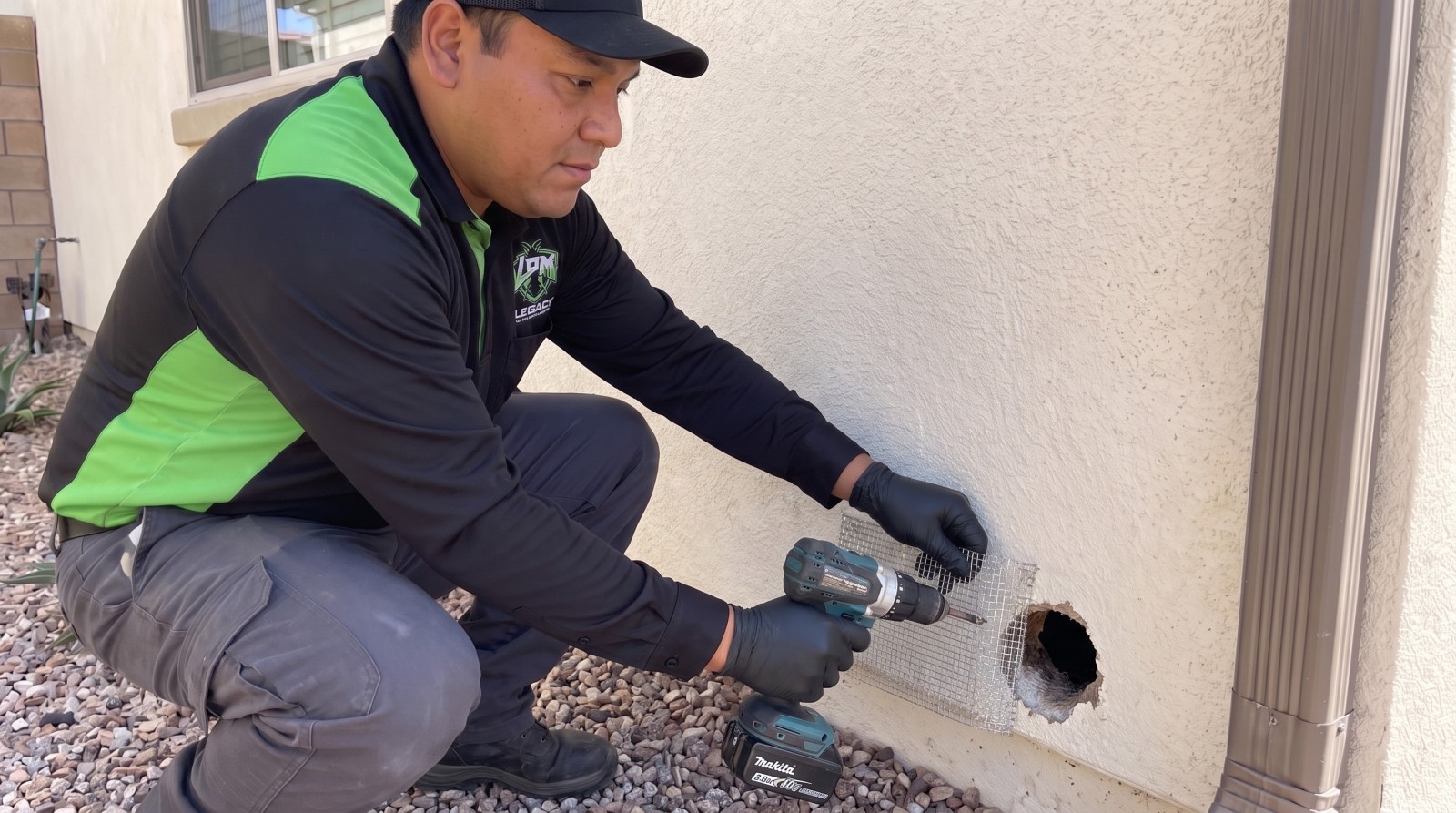
Almost every rodent job in San Diego County comes down to the same question: how is it getting in? Trapping removes the animals that are present. It does not remove the route, and it does not remove whatever is feeding them.
Call 619-277-4796 and tell us where you are hearing or seeing activity.
The County of San Diego identifies the roof rat as the most common rat in the county, and notes that they climb rather than burrow. The Norway rat, the burrowing sewer species people often assume they have, is not commonly found here.
That distinction decides the whole job. Roof rats nest above ground, in attics, wall voids and ceiling voids, and in dense vegetation outside. They travel along branches, fences and overhead utility lines, and they range up to 300 feet from a nest. If something is in your ceiling, it did not come up from a drain.
A few things reliably attract them. UC guidance names ivy, star jasmine and honeysuckle as harborage; the county adds bougainvillea and pyracantha. They eat citrus and avocado while the fruit is still on the tree, leaving a hollowed-out rind hanging from the branch, which is close to a signature.
Near canyon edges there is one more possibility worth knowing about. Native woodrats build stick nests and generally stay out of houses, though they will occupy outbuildings and occasionally vehicles. If something is nesting in your garage near open space, it may not be what you assume, and the response is different.
Sealing is not the finishing touch on a rodent job, it is the job. Where a property backs onto a canyon, a river corridor or open space, the population outside is permanent. You are not going to clear it. What you can do is make the building unavailable.
Two numbers are worth carrying: rats can squeeze under a gap of about half an inch, and sealing anything larger than a quarter inch is what excludes mice as well. Most of the openings that matter are not obvious. Rooflines, unscreened or damaged vents, utility penetrations, weep screeds, door thresholds and garage seals account for the great majority of what we find.
The other half is the bridge. A branch touching the eave, a fence running to the roof, ivy climbing a wall or a utility line arriving at the fascia are all routes, and cutting them back does more than any amount of trapping.
On rural and acreage properties the house is rarely where it starts. Feed is the single biggest driver: sacked grain and open bins are a food subsidy a suburban property simply does not have. Metal containers with tight lids, feed off the floor and spillage swept up will do more than any trapping program.
Barns, tack rooms, hay lofts, shops and detached garages are the harborage side of the same problem, and roof rats nest in exactly those enclosed elevated spaces.
One piece of cleanup guidance worth having. Deer mice carry hantavirus in San Diego County and live in rural areas, the mountains and the desert; common house mice do not carry it. Human illness is rare here, with four cases among county residents since 2000 and three of those contracted elsewhere. What matters practically is method: the county says explicitly not to sweep or vacuum droppings, urine or nesting material, because that puts dust in the air. Spray with a ten-to-one water and bleach solution, leave it fifteen to twenty minutes, then clean up wet.
You will read on a lot of pest control sites that rodents move indoors in autumn because it gets cold. We looked for support for that and could not find any from UC or California vector control, and it is a weak explanation in a county where January averages around 58 degrees.
What we do see is resource-driven: the end of backyard citrus and avocado season, landscaping cut back or a tree removed, irrigation shut off, or the first heavy rains flooding ground harborage. Those are the events that push activity toward buildings. That is a field observation rather than a published finding, and we would rather label it than dress it up.
Then the route and the food are still there. Trapping into an open supply is a treadmill. Sealing the entry and removing the food source is what ends it.
Droppings size, the gaps being used and where the sound is coming from usually tell us. It matters, because exclusion for mice has to be tighter.
Roof rats. Look for a branch, fence or vine reaching the roofline, and gaps at the eave or vents.
No. Cut the branches back so nothing touches the structure, pick fallen fruit up rather than leaving it, and seal the building. That gets you most of the way.
The population out there is permanent, so the goal is keeping them out of the structure rather than clearing the canyon. Exclusion and vegetation management do the lasting work.
Rodent Control commonly overlaps with these:
We run rodent control from both offices. See El Cajon or San Diego for the communities each one covers, or browse the full list of service areas. You can also send us a request, or read more about Legacy Pest Management.
Call 619-277-4796 or send a request and tell us what you are dealing with. We will recommend a plan that fits the property rather than a default package. We are open 24 hours a day, seven days a week.

Get Started
Tell us what you are seeing and where it is happening. You will get an honest assessment of the problem, what it takes to solve it, and whether your property needs ongoing service or a single visit. Pest, wildlife and termite work across San Diego County.