Fleas, ticks and mites are rarely a problem in isolation. They are almost always a symptom of something else: a pet, or a rodent, or an animal that was living in the structure and has since gone. Treating the fleas without dealing with the source is how people end up doing it three times.
Call 619-277-4796 and tell us whether there are pets in the home, whether anything has been nesting in the property, and whether you are finding anything above floor level.
The cat flea is the dominant flea on both cats and dogs, despite the name, and it is what we find in essentially every residential case.
The life cycle is the part worth understanding, because it explains why treatment sometimes appears to fail:
This is the single most useful thing on this page. A fully developed flea can stay dormant inside its cocoon for up to twelve months in cool conditions. Emergence is triggered by warmth plus mechanical pressure - footsteps on carpet, or vacuuming.
So a family returns from two weeks away, walks into the house, and is swarmed. Nothing arrived while they were gone. The pupae were already there, and the vibration told them a host had returned.
It also explains why vacuuming is genuinely part of the treatment rather than just tidying: it triggers emergence, which brings the fleas out to where treatment reaches them.
If there are no animals in the home, the source is usually one that left. Rodents in a wall or attic, an opossum or raccoon under the deck, or wildlife in a crawl space all carry fleas, and when the animal is removed or dies the fleas stay behind and start looking for a new host. That host is you.
This is why flea work and rodent or wildlife work so often go together, and why treating the fleas alone tends to be temporary.
One local health note, stated in proportion. Flea-borne typhus occurs in San Diego County at roughly one locally acquired case a year. A North Park resident was hospitalized with it in 2018 and recovered. It is carried by fleas living on rats, opossums, cats and other animals rather than by the animals directly. It is uncommon, it is treatable, and it is the practical reason we treat a rodent problem and a flea problem as one job rather than two.
Ticks split into two different problems, and they need different answers. Most companies quote them as one.
San Diego County has two common human-biting species. The western blacklegged tick is the only tick in California that transmits Lyme disease, and the Pacific Coast tick can carry tularemia and spotted fevers. The County is direct about the risk level: these diseases are rare here.
Rare is not the same as absent. Pacific Coast tick fever has been detected repeatedly across the county through 2025 and 2026, including in Ramona, Poway, Escondido and San Diego itself.
These ticks do not live in your house. They wait on vegetation along trails and in tall grass and brush, and climb on when something brushes past. So the answer is trail habits, tick checks and managing the brushy edge of the property, not an interior treatment. We will tell you that rather than sell you a service that cannot help.
The brown dog tick is the exception, and it is the one that becomes a pest control job.
It is the only tick in the United States that can complete its entire life cycle indoors. It prefers dogs to people, so where a dog lives, the population builds up inside the structure rather than out in the yard.
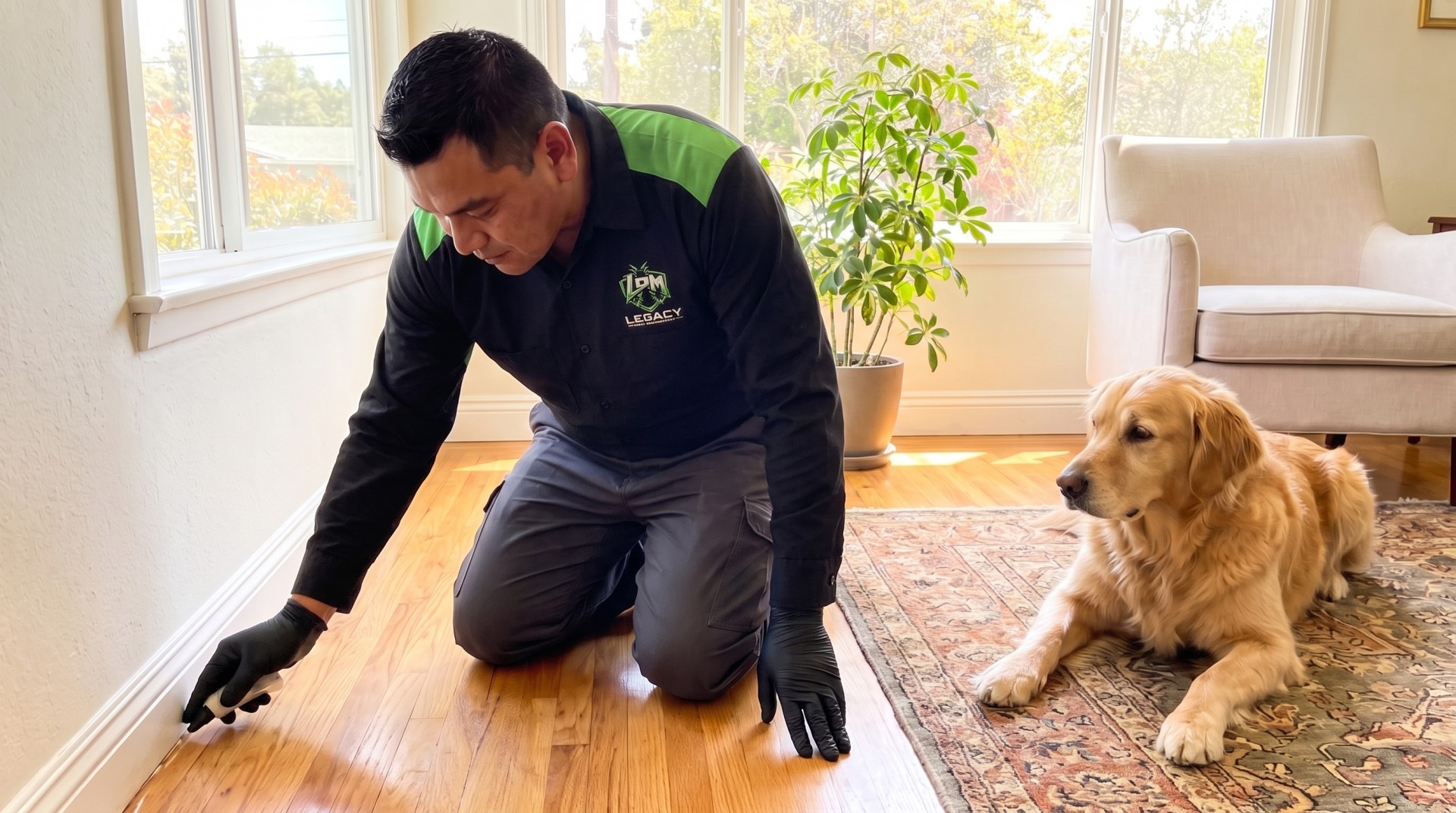
What that looks like in practice: ticks in the gaps along baseboards, behind pictures, at the junction of wall and ceiling, in bedding and crates, and climbing the wall near where the dog sleeps. People usually describe finding them well above floor level, and that is the giveaway, because a tick picked up on a trail does not do that.
It bites people mainly when numbers are high, which by definition means an established infestation. It can transmit Rocky Mountain spotted fever and tularemia.
Same principle as fleas: the animal and the building are one job, not two.
Brown dog ticks are genuinely difficult to clear once they are established, and anyone promising a single visit has not dealt with one. This is one of the cases where ongoing service earns its place.
Mites are a different situation and frequently misidentified, including as bed bugs.
Bird and rodent mites are the ones we most often deal with. They live on a host animal, and when a nest is abandoned or removed - a bird nest in an eave, rodents cleared from an attic - the mites disperse into the building looking for a replacement. People report biting and irritation with nothing visible, because these mites are very small.
The treatment sequence matters: the nest or host has to be dealt with first. Treating the interior while an active nest sits in the eave produces a repeat visit.
Flea control is a three-part job and skipping any one part causes failure:
Hot-water laundering of pet bedding, and a household dryer on high, handles the launderable side.
Flea populations increase sharply through spring and early summer as conditions favor larval development, and stay high through the warm months. Shaded, irrigated yards hold the humidity larvae need even when the wider landscape is dry, so the yard is often the reservoir.
Normal, and not a failure. Pupae that were already present emerged after the treatment, triggered by activity in the house. That is why the program is staged rather than a single application, and why vacuuming between visits helps.
Usually an animal that was in the structure - rodents, or wildlife under a deck or in a crawl space. Finding that is part of the job.
Different insects, different sources, completely different treatment. Fleas jump and are associated with pets and animals; bed bugs are found in and around the bed. Getting this wrong sends the whole job in the wrong direction, so identification comes first.
Sometimes. Where pets rest outside in shaded, irrigated areas, that is often where the larvae are. It depends on the property.
Expect several weeks rather than days, because the pupal stage is protected and emerges over time. Anyone promising same-day resolution is not describing the life cycle.
Flea & Tick Treatment is part of our General Pest Control program, and commonly overlaps with these:
We handle flea, tick and mite work from both offices. See El Cajon or San Diego for the communities each one covers, or browse the full list of service areas. You can also send us a request, or read more about Legacy Pest Management.
Call 619-277-4796 or send a request and tell us what you are dealing with. We will recommend a plan that fits the property rather than a default package. We are open 24 hours a day, seven days a week.
Get Started
Tell us what you are seeing and where it is happening. You will get an honest assessment of the problem, what it takes to solve it, and whether your property needs ongoing service or a single visit. Pest, wildlife and termite work across San Diego County.